Choosing between Scaleway vs OVH in 2026 is not the same conversation it was three years ago. Both providers have matured substantially — OVHcloud now spans 46 data centres across four continents while Scaleway has doubled down on its European density and GPU-first AI platform. Meanwhile, a sharp increase in DRAM prices has forced both providers to reprice their entry-level tiers, reshaping the value calculus for budget-sensitive buyers.
If you're an engineering team, startup, SaaS company, or regulated enterprise operating under GDPR and looking for a cloud provider that keeps your data firmly inside the EU, this comparison cuts through the marketing to give you a clear, data-backed recommendation. We've drawn on independent benchmark data, provider pricing pages, and the experience of Gart Solutions' architects — who advise clients across CEE, DACH, and Benelux on exactly these decisions.
TL;DR
In the Scaleway vs OVHcloud comparison, Scaleway leads on compute value-per-euro, developer experience, and AI/GPU infrastructure under full EU isolation.
OVHcloud leads on global edge presence, regulated-industry certifications (SecNumCloud, HDS), and support for VMware/legacy migrations.
Both providers are fully immune from the US CLOUD Act — a genuine differentiator over US hyperscalers.
A 2026 RAM price surge has made entry-level VPS tiers more expensive across both providers; the value gap at mid-tier compute has narrowed.
For most EU-native SaaS teams: Scaleway. For enterprises in Finance, Healthcare, or Public Administration: OVHcloud.
46
OVHcloud data centres globally
31+
OVHcloud Local Zones
3-AZ
Scaleway regions in EEA
~2×
Scaleway value vs AWS (Callista 2026)
Company overview
OVHcloud
Founded in 1999 in Roubaix, France, OVHcloud is the largest EU-native cloud provider by revenue and infrastructure scale. As of 2026 it is publicly traded on Euronext Paris and serves 1.6 million customers across 140+ countries from 46 data centres on four continents. What makes OVHcloud unusual at its scale is vertical integration: the company designs its own server hardware, builds its own data centres, and operates its own fibre backbone. That industrial model gives it tight cost control and predictable SLAs — but also means slower iteration cycles than more software-defined providers.
Scaleway
Scaleway is a subsidiary of Iliad Group — the French telecoms holding company that also owns Free Mobile — and positions itself as the "European Public Cloud and AI Platform." Its footprint is smaller but dense within the EEA: primary regions in Paris, Amsterdam, and Warsaw, with a 2026 Milan expansion (MIL1) and a roadmap covering Sweden and Germany. Scaleway's identity is shaped by developer velocity: fast provisioning, clean APIs, transparent billing, and an increasingly serious GPU fleet underpinned by NVIDIA Blackwell and Hopper hardware.
Scaleway vs OVHcloud: Pricing and cost structure
The 2026 pricing environment for both providers has been reshaped by a roughly 30% increase in RAM costs compared to late 2025, driven by global memory supply constraints. Both OVHcloud and Scaleway passed these increases on to customers — though the impact was felt most sharply in entry-level VPS tiers.
OVHcloud's April 1, 2026 pricing update moved its VPS-1 plan from roughly €3.50 to €7.60 — a near-doubling of cost — while mid-tier and bare metal instances saw more moderate increases of 10–20%. Scaleway's pricing adjustments were similarly tiered, with general-purpose instances absorbing smaller increases than memory-heavy configurations.
At mid-tier compute (four vCPUs, 8 GB RAM), Scaleway's PLAY2-MICRO and OVHcloud's VPS-2 sit at broadly comparable price points. The more meaningful differentiator is egress. Scaleway offers free egress for most services (tiered by instance size), while OVHcloud's egress model is volume-based. For SaaS teams with unpredictable traffic spikes, Scaleway's model eliminates a significant billing uncertainty.
Plan
OVHcloud
Scaleway
Entry VM (1 vCPU, 2 GB)
~€7.60 (VPS-1)
~€4.99 (PLAY2-PICO) Better value
Mid VM (4 vCPU, 8 GB)
~€14 (VPS-2)
~€14 (PLAY2-MICRO)
Managed Postgres (2 vCPU, 4 GB)
Comparable
Comparable
Object storage (1 TB)
Competitive
Competitive
Egress model
Volume-based
Free (tiered by instance) Advantage
Independent benchmarks by Callista in February 2026 found that Scaleway delivers approximately twice the value per euro of AWS, achieved by offering nearly double the single-core performance of equivalent hyperscaler instances at roughly one-quarter of the price. OVHcloud is similarly competitive against hyperscalers, though Scaleway holds a narrow edge for raw compute cost efficiency.
💰
Egress costs are often the hidden budget killer.
When we model total cloud spend for clients migrating from AWS or Azure to a European provider, egress routinely accounts for 15–25% of monthly bills.
Gart Solutions' FinOps and cloud cost optimisation practice helps teams model full-cost comparisons before committing to a provider.
Scaleway vs OVH: Infrastructure and regional availability
OVHcloud's global scale is its clearest differentiator over Scaleway. With 46 data centres and 31+ Local Zones in high-density urban areas — from Dallas to Tallinn — it is the only EU-native provider that can credibly serve latency-sensitive workloads across multiple continents from a single control plane.
Local Zones deserve a closer look. These are lightweight, modular public cloud environments that OVHcloud can deploy in weeks, often achieving sub-2ms latency for applications like live streaming and real-time retail. The limitation worth noting: Local Zones do not support OVHcloud's vRack private networking natively (requiring VPN overlays), and managed services like Kubernetes and Databases are not available there.
Scaleway's model is "European Hyperscale" — fewer total data centres, but every primary region is built with full 3-AZ redundancy from inception. Warsaw (WAW1/WAW2/WAW3) offers strong proximity for CEE and Ukrainian market traffic; Amsterdam anchors North/West European latency; the new Milan MIL1 region serves Southern Europe. For teams whose users are concentrated in the EEA, this depth is functionally equivalent to OVHcloud's broader footprint.
Region
OVHcloud
Scaleway
Paris, France
3-AZ
3-AZ
Warsaw, Poland
1-AZ
3-AZ Deeper
Amsterdam, Netherlands
Peering focus
3-AZ
Milan, Italy
3-AZ
3-AZ
North America
✅ Multiple regions
✗
Asia-Pacific
✅ Multiple regions
✗
AI and GPU infrastructure
This is arguably the most consequential comparison for 2026 buying decisions, as GPU compute has become the dominant driver of cloud infrastructure investment.
Scaleway has positioned its GPU fleet as the centrepiece of its European AI platform strategy, backed by significant capital from Iliad Group. Its current lineup includes NVIDIA Blackwell B300-SXM instances with 288 GB VRAM — the most advanced EU-native GPU offering available — alongside Hopper H100 (SXM and PCIe) for LLM fine-tuning and Ada Lovelace L40S/L4 for cost-efficient inference. The infrastructure scales to distributed training clusters of 1,000+ GPUs, providing the foundation for frontier European AI labs including Mistral AI.
OVHcloud's GPU strategy centres on bare metal access: direct hardware provisioning for researchers and enterprises who need full control over the stack. Its portfolio spans eight models including the H100, RTX 5000, and A10, with an "AI Deploy" service for pay-as-you-go notebook and inference deployment.
GPU model
OVHcloud (est.)
Scaleway (est.)
NVIDIA H100 PCIe
~€2.90/hr
~€2.99/hr
NVIDIA L40S
~€1.50/hr
~€1.45/hr
NVIDIA L4
~€0.60/hr
~€0.55/hr
NVIDIA Blackwell B300
Not available
Available EU-first
For LLM training at scale, Scaleway's Blackwell availability is a category-defining lead. For enterprise inference workloads where bare metal isolation and SecNumCloud certification coverage matter more than cutting-edge specs, OVHcloud's model is a defensible choice.
Scaleway vs OVH: Managed Kubernetes and serverless
Scaleway Kubernetes Kapsule is the choice most often recommended by our team for EU-native developers. It integrates cleanly with Scaleway's VPC, benefits from the Cockpit observability tool, and supports ARM-based node pools for cost-efficient workloads. Provisioning speed is notably fast, and the control plane is stable for production use by teams without dedicated platform engineers.
OVHcloud Managed Kubernetes has a steeper management interface but is the more battle-tested choice for high-traffic, multi-node clusters where egress performance and global backbone access matter. It's also the natural choice if your workload requires Local Zone edge deployment or tight integration with OVHcloud's bare metal and VMware Private Cloud offerings.
On serverless, Scaleway's Functions, Containers, and Jobs platform is mature and cost-efficient. A benchmark for 25 million executions at 512 MB memory / 150ms duration places Scaleway serverless at roughly €5–6/month — materially cheaper than equivalent AWS Lambda or GCP Cloud Run at that scale.
🔧
Kapsule vs OVHcloud Managed Kubernetes?
In our DevOps engagements, Kapsule consistently delivers faster time-to-production for greenfield workloads. Teams migrating existing clusters should evaluate OVHcloud if they need Local Zone placement.
Gart Solutions' DevOps and platform engineering practice designs migration paths for both directions.
Data sovereignty and compliance
Both providers are fully immune from the US CLOUD Act — the most fundamental data sovereignty requirement for EU-regulated workloads. Neither has a US parent company, which is the critical distinction that US hyperscalers cannot replicate regardless of their European infrastructure investments.
However, the compliance differentiation within the EU-native tier is real. OVHcloud holds a more extensive portfolio of high-level certifications: SecNumCloud-qualified Private Cloud (France's highest security standard), HDS for healthcare data hosting, and ISO 27001 across its core infrastructure. For organisations in Finance, Healthcare, and Public Administration facing regulatory audits, these certifications reduce compliance risk materially.
Scaleway is aligned with GAIA-X and is pursuing SecNumCloud certification across more of its product line. Its operational sovereignty is strong — approximately 90% of its hardware vendors are European — but it does not yet match OVHcloud's breadth of third-party certification.
One nuance worth flagging: OVHcloud faced a 2024 ruling by an Ontario Court of Justice compelling its Canadian subsidiary to produce data stored in European facilities. This "virtual presence" doctrine is a reminder that OVHcloud's global footprint introduces cross-jurisdictional legal vectors absent from more regionally confined providers. For organisations with absolute sovereignty requirements, Scaleway's tighter EEA perimeter reduces this risk.
Compliance metric
OVHcloud
Scaleway
CLOUD Act exposure
Zero
Zero
SecNumCloud
✅ Private Cloud Certified
In progress
HDS (Healthcare)
✅
Partial
ISO 27001
✅
✅
Global jurisdictional risk
Present (Canadian subsidiary ruling)
Lower (EEA-focused)
Compute performance and hardware
OVHcloud's 2026 compute strategy is built around its custom-manufactured Bare Metal 2026 line: servers running AMD EPYC 4005 and 9005 series processors, water-cooled for high power density. The "Game 2026" range uses AMD Ryzen 9000 X3D processors with large L3 caches for gaming and interactive workloads. At the high end, Scale and High Grade bare metal ranges offer up to 384 cores and 3 TB of DDR5 RAM — suited to virtualisation platforms, HPC, and large-scale database workloads.
Scaleway's POP2 and PRO2 instance series balance x86 and ARM (Neoverse-N1) architectures, delivering strong throughput for web and application workloads. Its Elastic Metal offering provides cloud-native bare metal with VPC integration and fast provisioning. Uniquely, Scaleway also offers Apple Silicon as-a-Service — Mac Mini M1 through M4 Pro instances for CI/CD pipelines and macOS-specific development.
On provisioning speed, benchmarks show Scaleway averaging around 30 seconds for instance creation versus OVHcloud VPS averaging approximately 800 seconds in mixed samples. For teams running ephemeral infrastructure or autoscaling events, that gap has operational consequences.
Developer experience and support
Scaleway consistently wins on developer experience. Its dashboard is clean, its CLI is fast and intuitive, and its API design follows modern REST conventions that integrate naturally with Terraform and Pulumi. The Cockpit observability tool — consolidating metrics, logs, and alerts — reduces the toolchain overhead that typically accompanies infrastructure operations.
OVHcloud's control panel has improved but remains more complex to navigate — a natural consequence of the breadth of services it covers. Its CLI is powerful and supports fine-grained Kubernetes node pool management, but has a steeper onboarding curve. For smaller teams or solo developers, Scaleway's simpler surface area is a real productivity advantage.
Support tier
OVHcloud P1 response
Scaleway P1 response
Standard
8 business hours
8 hours
Advanced/Premium
Varies
2 hours
Business
30 minutes
30 minutes
Enterprise
15 min + TAM TAM included
15 minutes
OVHcloud's Enterprise tier inclusion of a dedicated Technical Account Manager is a meaningful differentiator for large organisations that need a named point of contact for complex environments. For most engineering teams, the response time parity at Business and Enterprise tiers means support quality is not a deciding factor.
Who should choose which provider
Expert Verdict
Choose Scaleway if…
Building or scaling AI/LLM workloads requiring Blackwell or Hopper GPUs under full EU sovereignty
Your team prioritises developer velocity — clean APIs, fast provisioning, minimal operational drag
Running SaaS with variable egress and wanting predictable, transparent billing
Users are concentrated in the EEA with no APAC or North American coverage needed
Apple Silicon CI/CD or ARM-based compute at scale
SMB or startup optimising for performance-per-euro at mid-tier compute
Expert Verdict
Choose OVHcloud if…
Regulated workloads in Finance, Healthcare, or Public Administration requiring SecNumCloud or HDS certification
Migrating a VMware or Nutanix on-premise environment requiring hybrid cloud integration
Application demands global edge presence — 31+ Local Zones across four continents
Serving users in North America or Asia-Pacific with EU-native legal status
Running high-density bare metal HPC requiring up to 384 cores and 3 TB DDR5 RAM
Enterprise contracts requiring a dedicated Technical Account Manager
Conclusion
The Scaleway vs OVHcloud decision in 2026 is not primarily a question of trust or security — both providers earn that baseline with full CLOUD Act immunity and credible EU operations. The question is which architectural philosophy matches your team's trajectory.
Scaleway has evolved into Europe's most technically ambitious cloud platform for AI and developer-centric workloads. Its Blackwell GPU fleet, fast provisioning, transparent billing, and clean developer experience make it the natural home for high-velocity engineering teams and European AI labs that need sovereign compute without hyperscaler pricing.
OVHcloud has built something different and equally valuable: an industrial-grade sovereign cloud platform with a global edge network, the deepest certification portfolio in the EU-native sector, and the hybrid integration capabilities that regulated enterprises need when they can't afford to leave legacy infrastructure behind overnight.
For most teams reading this in 2026: if your workload is cloud-native and your users are in Europe, start with Scaleway. If you run regulated workloads, need global edge presence, or are migrating complex on-premise environments, evaluate OVHcloud seriously. And if you're unsure — that's precisely the conversation our architects have every week with clients across the continent.
Ultimately, the Scaleway vs OVH decision comes down to whether you prioritise developer velocity and AI infrastructure, or compliance depth and global reach.
Choosing between Hetzner and DigitalOcean is one of the most impactful infrastructure decisions a growing company can make in 2026. Get it right and you'll slash your cloud bill while scaling effortlessly. Get it wrong and you'll either overpay for raw compute — or find yourself drowning in ops overhead your team isn't equipped to handle. This guide cuts through the noise.
4×
More RAM for the same price on Hetzner EU
80%
Avg. bandwidth cost reduction after migration
64%
Average cloud cost savings achieved by Gart clients
Why this comparison matters more in 2026
The cloud market has matured significantly. What was once a conversation dominated by AWS, Azure, and GCP is now a nuanced landscape where boutique infrastructure providers deliver performance that rivals the hyperscalers — at a fraction of the cost.
DigitalOcean has doubled down on its managed services ecosystem, adding Kafka, Valkey, and its Gradient AI inference cloud to an already rich platform. Meanwhile, Hetzner has quietly expanded beyond Europe, opening data centers in Virginia, Oregon, and Singapore — while maintaining its unbeatable price-to-performance ratio in Germany and Finland.
For SMBs and high-growth startups, this isn't an academic debate. The wrong cloud provider can silently consume your entire profit margin through egress charges, over-provisioned resources, or managed service lock-in.
Gart's take: After migrating dozens of clients across cloud providers, we've learned that neither platform is universally better. The right choice depends on your team's operational maturity, traffic profile, geographic requirements, and growth trajectory. Read on to find yours.
Architecture and positioning: two very different bets
DigitalOcean — the developer's cloud
DigitalOcean's core bet has always been developer velocity. The "Droplet" abstraction turned a generation of web developers into infrastructure operators. In 2026, DOKS (Managed Kubernetes), a free control plane, one-click databases, and the App Platform PaaS make it possible for a two-person startup to run a production-grade stack without a dedicated DevOps hire.
The trade-off is cost. You're paying a significant premium for that abstraction layer — and the Basic Droplet CPU credit model means your $6/month VPS may not perform like a $6/month VPS under sustained load.
Hetzner — raw performance, exceptional economics
Hetzner owns its data centers outright. That vertical integration — combined with AMD EPYC processors, ARM64 Ampere Altra instances, and NVMe RAID10 storage — means you're getting near-bare-metal performance at virtualized prices. Their CPX shared instances don't throttle CPU credits. Their EU regions include 20 TB of outbound traffic per server.
The trade-off is operational responsibility. Hetzner is a "raw resource" provider. High availability, Kubernetes orchestration, managed databases — all of that is on you (or your DevOps partner).
Pricing: the egress trap and what it actually costs you
Infrastructure pricing is never just the instance cost. The "hidden killer" for high-traffic applications is data egress. Here's the real picture:
Pricing Metric
DigitalOcean
Hetzner (EU)
Hetzner (US / SG)
Entry VM cost
$6.00 / mo — 1 GB RAM
~$4.03 / mo — 4 GB RAM Winner
~$4.03 / mo — 4 GB RAM
Included traffic
1 TB (pooled)
20 TB per server Winner
0.5 – 1 TB per server
Egress overage
$10.00 / TB
€1.00 / TB Winner
€1.00 – €7.40 / TB
Managed DB (min)
$15.00 / mo Trade-off
Not offered (standard cloud)
Not offered
Block storage
$10 / 100 GB min
$4 / 100 GB min Winner
$4 / 100 GB min
Real-world math: An application transferring 100 TB of data monthly pays approximately $900 in egress overages on DigitalOcean. The same workload on Hetzner EU costs roughly €80. For a bootstrapped SaaS, that delta is often the difference between profit and loss.
Performance benchmarks: does cheaper mean slower?
Short answer: no. Independent benchmarks from 2023–2025 consistently show Hetzner matching or exceeding DigitalOcean across CPU throughput, memory bandwidth, and disk I/O — often at a lower price point.
Apache (req/sec at 1000 concurrent)
Hetzner CPX22
6,836
DigitalOcean
6,550
Memory bandwidth — Stream Add (MB/s)
Hetzner CPX22
24,839
DigitalOcean
18,062
Avg. instance provisioning time
Hetzner
~25s
DigitalOcean
~45s
The performance gap becomes most visible under sustained load. DigitalOcean Basic Droplets use a CPU credit model — once credits are exhausted, throttling kicks in. In a 500-concurrent-user load test, a $6 DigitalOcean Droplet's response time climbed past 6 seconds at peak, while a cheaper Hetzner instance held steady at 1.8 seconds with near-zero failed requests.
Managed services: DigitalOcean's strongest card
This is where DigitalOcean genuinely pulls ahead, and it's the primary reason teams choose it over Hetzner.
Service
DigitalOcean
Hetzner Online
Managed Kubernetes
Fully managed DOKS, free control plane
Manual deploy only — no native offering in 2026
Managed databases
Postgres, MySQL, Redis, MongoDB, Kafka
LAMP on Managed Servers only
PaaS / App Platform
GitHub-connected auto-deploy
Not offered
Serverless functions
Available
Not offered
Object storage
Spaces (S3 compatible)
S3-compatible object storage
Hetzner has confirmed that managed Kubernetes is on its roadmap, but as of 2026 it remains unavailable natively. Teams running Kubernetes on Hetzner today use Terraform, cluster-api-provider-hetzner, or third-party platforms like Cloudfleet — all viable, but requiring DevOps expertise to implement and maintain.
Gart's take: The absence of managed services on Hetzner is often presented as a dealbreaker. In practice, it's a solvable problem. With the right IaC setup and automation, we provision production-grade Kubernetes clusters on Hetzner in under 2 hours — at 60–70% lower monthly cost than equivalent DOKS setups.
Reliability, SLA, and support: the enterprise consideration
Service
DigitalOcean
Hetzner Online
Managed Kubernetes
Fully managed DOKS, free control plane
Manual deploy only — no native offering in 2026
Managed databases
Postgres, MySQL, Redis, MongoDB, Kafka
LAMP on Managed Servers only
PaaS / App Platform
GitHub-connected auto-deploy
Not offered
Serverless functions
Available
Not offered
Object storage
Spaces (S3 compatible)
S3-compatible object storage
DigitalOcean's 99.99% SLA is meaningful if you need to underwrite reliability guarantees to your own enterprise clients. Hetzner's infrastructure is in practice highly reliable — many users report years without unplanned downtime — but the absence of a formal SLA means HA architecture is the operator's responsibility.
Both providers require you to architect for failure. Neither offers automatic cross-region failover out of the box.
Global reach and data sovereignty
DigitalOcean maintains 14 data centers across 11 regions — North America, Europe, Asia, and Australia — giving it a clear geographic advantage for globally distributed applications. Its presence in Bangalore and Sydney is particularly valuable for teams targeting Indian and Australian markets.
Hetzner's primary strength remains Europe. Its German data centers operate under strict GDPR jurisdiction, are powered entirely by renewable energy, and carry BSI C5 certification — making Hetzner the preferred choice for European FinTech, HealthTech, and any organization building sovereignty-first infrastructure away from US CLOUD Act exposure.
Hetzner's 2024 Singapore expansion and existing US presence in Ashburn and Hillsboro close part of the gap, but with significantly lower included traffic allowances than their EU regions (0.5–1 TB vs 20 TB).
How to choose: the honest decision framework
Choose DigitalOcean if…
✓Your team needs to focus entirely on product, not server ops
✓You require a formal 99.99% SLA for enterprise or insurance purposes
✓You need global reach — India, Australia, Canada, or East Asia
✓Managed Kafka, OpenSearch, or Valkey saves you significant engineering time
✓You want App Platform PaaS for simple deploy-from-GitHub workflows
Choose Hetzner if…
✓High bandwidth egress would be financially unsustainable elsewhere
✓You have DevOps expertise in-house — or a partner like Gart Solutions
✓European data sovereignty and GDPR compliance are non-negotiable
✓You're running high-traffic SaaS, gaming, or media platforms
✓You need dedicated root servers or dedicated vCPUs for compute-heavy workloads
Unlock Hetzner's full potential — without the ops overhead
The biggest reason teams avoid Hetzner isn't cost or performance — it's the operational complexity of running production infrastructure without managed services. Gart Solutions eliminates that barrier. We build automated, HA-ready Kubernetes clusters, CI/CD pipelines, monitoring stacks, and managed database setups on top of Hetzner's hardware — giving you hyperscale capability at boutique pricing.
Talk to our cloud team →
How Gart Solutions bridges the gap
Over the past several years, Gart Solutions has built a specialized practice around exactly this challenge: helping digital-first companies achieve the operational sophistication of AWS or DigitalOcean on top of Hetzner's cost-effective infrastructure — or optimizing their existing DigitalOcean footprint to eliminate waste.
Our cloud migration methodology
We follow a five-phase approach designed to minimize risk and maximize long-term efficiency:
Phase 1 — Assessment and discovery. A 30–40 hour deep-dive into your existing stack. We map application dependencies, classify data by criticality, and build a Total Cost of Ownership model that predicts your monthly spend in the target environment before you commit to anything.
Phase 2 — Architecture design. Whether you need a Lift & Shift for speed or a full re-platforming to cloud-native services, we document a custom target architecture with clear timelines, roles, and costs.
Phase 3 — Migration execution. We provision the new environment with Terraform or Pulumi and execute cutover using blue-green or canary deployment strategies — targeting zero downtime.
Phase 4 — Operations and monitoring. Post-migration, we implement Prometheus, Grafana, and alerting pipelines so your team has full observability from day one.
Phase 5 — Continuous optimization. Cloud costs drift. We perform regular reviews to eliminate idle resources and right-size provisioning. Our clients achieve an average of 64% cost reduction in the cloud.
📂 Case study
Transforming a local landfill solution into a global platform
Cloud cost optimization
Cloud infrastructure management
Hetzner migration
IT infrastructure & DevOps consulting
Client
ReSource International
Industry
GreenTech
Partnership
3 years
Location
🇮🇸 Iceland🇸🇪 Sweden🇫🇷 France
Technologies
Ansible
Docker
Docker Swarm
Hetzner
Terraform
About the client
ReSource International is an Icelandic company specializing in environmental solutions. They developed elandfill.io — a comprehensive digital platform for monitoring and managing landfill operations globally.
Optimize daily operations and track assets
Centralize data collection, analysis, and action
Facilitate data analysis and import/export
Tailored tools for landfill management (gas, leachate, waste input)
Web-based interface with weather impact insights
Challenges
🗺️
Geoserver management
Handling and processing large geospatial imagery data efficiently.
🗄️
Database management
PostgreSQL and PostGIS for storing geospatial data, locations, and GPS coordinates.
⚡
Real-time data processing
Processing and analyzing large volumes of data from various modules in real-time.
🔗
Module integration
Ensuring seamless communication and data transfer between different modules.
🚨
Alert system
Implementing alerts when emissions or other parameters exceed permissible limits.
🚛
Operations optimization
Efficient routing of waste collection vehicles based on real-time monitoring data.
Solution
Gart developed the Resource Management Framework (RMF) — a suite of tools and approaches designed to deploy powerful digital solutions for landfill management globally.
1
Configuring and optimizing services to manage all components effectively.
2
Optimizing the client's legacy system with proper resource allocation and utilization.
3
Implementing robust security measures to protect sensitive environmental data.
Results
🌍
From local to global
ReSource International scaled elandfill.io from a local Icelandic business to a global platform — successfully expanding into the French and Swedish markets. The RMF empowers their clients to optimize operations, ensure compliance, and promote environmental sustainability worldwide.
★★★★★
Verified review on Clutch
See the full client review →
⚡ Partner spotlight
Ready to migrate? Gart Solutions makes it zero-risk.
Navigating the shift from DigitalOcean to Hetzner — or optimizing an existing multi-cloud footprint — demands precision engineering. Gart Solutions is the specialist DevOps and Cloud partner built exactly for this moment, with a proven track record across SMB and enterprise migrations.
64%
Average cloud cost reduction per migration
90%
Infrastructure cost reduction (selected DigitalOcean→Hetzner)
200×
Operational efficiency via automation
0
Downtime on lift & shift migrations
The 5-stage migration framework
01
Assessment — 1–2 weeks
Deep-dive infrastructure audit identifying all dependencies, security posture gaps, and immediate "Quick Win" cost-reduction opportunities.
02
Roadmap design — 1–2 weeks
Tailored migration strategy with defined security frameworks (GDPR, HIPAA), KPIs, and risk mitigation plans before a single workload moves.
03
Seamless migration — 4–10 weeks
Zero-disruption execution using Lift & Shift and re-platforming methodologies. Business continuity is the non-negotiable constraint throughout.
04
Testing & optimization — 2–4 weeks
Post-migration performance tuning, security validation, and cost model verification against pre-agreed KPIs in the new environment.
05
Ongoing 24/7 maintenance
Continuous monitoring, proactive patching, and expert support to keep your infrastructure at peak health — indefinitely.
🎯 Free IT audit & cloud savings projection
No commitment. Gart's team maps your current spend, identifies vulnerabilities, and projects exactly how much you could save — before any contract is signed.
Book free consultation →
What defines real compliance in 2026 is sovereignty — who legally controls your infrastructure, who holds the cryptographic keys, who operates your systems, and which jurisdiction ultimately governs access to your data.
European organizations can host data in Frankfurt, Paris or Stockholm — and still remain exposed to non-EU authorities. That is why digital sovereignty has become the new compliance baseline across healthcare, finance, SaaS, public sector, manufacturing, and AI-driven businesses.
What Is Digital Sovereignty and Why Does It Matter for Europe?
The vast majority of cloud infrastructure today is controlled by U.S.-based hyperscalers like Amazon Web Services (AWS), Microsoft Azure, and Google Cloud.
These companies operate under U.S. law — most notably the CLOUD Act, which gives U.S. authorities the right to access data, even if it’s stored in European data centers.
This legal loophole creates an enormous risk. European governments, hospitals, banks, and startups often host sensitive workloads on foreign infrastructure without realizing they’re potentially exposing themselves to surveillance, data requests, and jurisdictional conflicts. Digital sovereignty is about correcting that imbalance — ensuring that European data stays in Europe, governed by European laws.
Sovereignty vs Residency vs Jurisdiction — The Control Framework
LayerWhat it controlsWhy it mattersData ResidencyWhere data is physically storedDetermines GDPR applicabilityData SovereigntyWhich legal system governs operationsDetermines NIS2, DORA & AI Act complianceJurisdictional ControlWho can legally compel accessDetermines CLOUD Act exposureSovereignty vs Residency vs Jurisdiction — The Control Framework
Sovereignty is not about geography.It is about legal authority, operational control, and cryptographic ownership.
But it’s more than just regulation. Digital sovereignty also touches on values — privacy, transparency, innovation, and economic sustainability. It’s a vision of a Europe that’s not just connected, but digitally independent.
The Data Explosion and Why Europe Is Reacting Now
Europe is generating data at unprecedented speed. Global data volumes grew from 33 zettabytes in 2018 to an estimated 175 zettabytes by 2025 — doubling roughly every 18 months. Yet despite this growth, the majority of European data is stored on infrastructure outside the EU, often governed by foreign laws.
The challenge is not just the volume of data, but the sensitivity of what is being collected:health records, financial data, industrial telemetry, geolocation streams, and now AI training datasets.Even metadata — logs, diagnostics, access patterns — can reveal valuable operational insights.
Rising cyberattacks, geopolitical tension, and the accelerating adoption of AI have pushed European regulators to tighten control over where data resides, how it moves, and who can legally access it.
Digital sovereignty is Europe’s answer to protecting its data economy while enabling innovation.
The Legal and Ethical Imperatives Behind Sovereign Cloud Choices
When a European organization uses a U.S.-based cloud provider, it may be fully GDPR-compliant on paper, but in reality, there's a major legal contradiction. That’s because foreign laws can override EU protections through extraterritorial reach. The U.S. CLOUD Act is a prime example. It allows American law enforcement to demand access to data, no matter where it's stored, as long as it's held by a U.S.-controlled entity.
This creates a fundamental conflict with the General Data Protection Regulation (GDPR) — which mandates strict data processing, protection, and transparency rules for all EU citizens. If a cloud provider is subject to both laws, whose orders do they follow?
This ethical and legal tension has spurred the development of sovereign cloud solutions. EU-based cloud providers offer an escape from this conundrum. They're headquartered and operated under European jurisdiction, meaning they can comply fully with EU data protection laws without foreign interference.
Levels of Sovereignty: Residency, Sovereignty, and Jurisdictional Control
Not all “sovereign clouds” offer the same guarantees. European organizations need to distinguish three layers of control:
1. Data ResidencyWhere the data physically lives. Hosting data in the EU ensures GDPR applies, but it does not eliminate risks if the provider is subject to foreign laws.
2. Data SovereigntyWhich legal system governs the data. True sovereignty ensures all processing, backup, and metadata are controlled by EU regulations only.
3. Jurisdictional ControlWho can compel access to the data.Even if stored in Frankfurt or Paris, data managed by a foreign-owned company may still fall under the CLOUD Act or other extraterritorial laws.
This framework helps organizations evaluate whether a cloud provider truly protects their data — or simply meets residency requirements on paper.
Why Digital Sovereignty Became Mandatory in 2025–2026
A regulatory triad has fundamentally redefined cloud compliance:
NIS2 – Supply-Chain Accountability
Organizations must maintain full visibility and control over their infrastructure supply chain — including subcontractors, MSPs, SaaS platforms, and cloud operators. Contracts alone are no longer sufficient.
DORA – Operational Resilience
Regulated sectors must demonstrate resilience, exit strategies, multi-vendor survivability, and continuity under failure — eliminating concentration risk on single hyperscalers.
EU AI Act – Sovereign AI Infrastructure
High-risk AI systems must operate entirely under EU jurisdiction, including training pipelines, inference environments, logs, telemetry and metadata.
US CLOUD Act – Jurisdictional Backdoor
US-controlled cloud providers can be legally compelled to provide access to EU-hosted data — creating a permanent sovereignty conflict.
Why Europe Needs Its Own Cloud Ecosystem
Dependency on Foreign Hyperscalers
As of 2025, American tech giants control more than 70% of Europe’s cloud infrastructure. That’s a staggering figure — and one that leaves little room for self-determination.
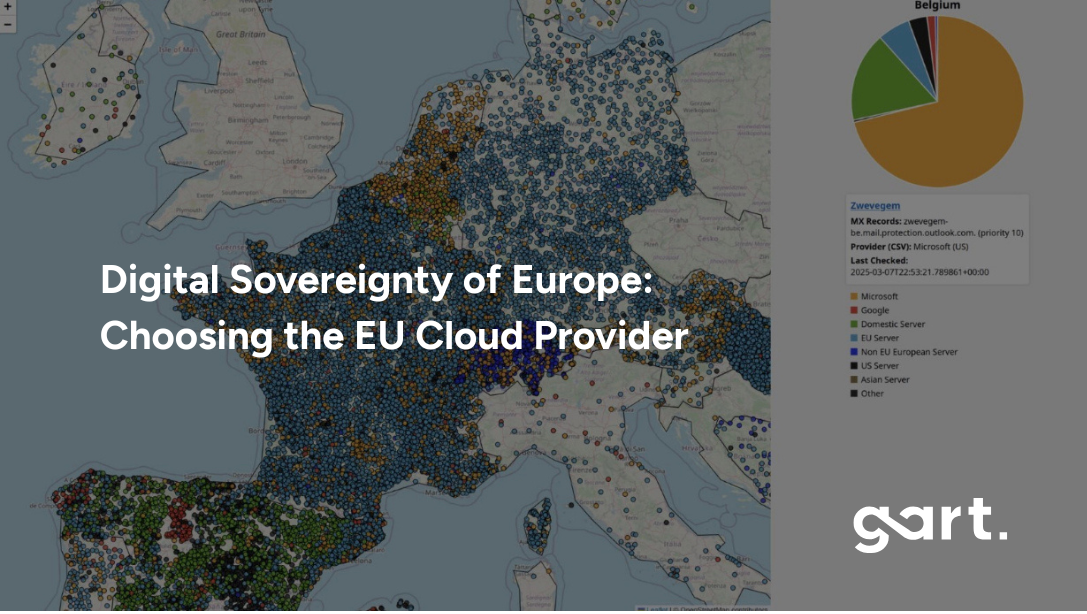
Let’s take, for example, Belgium – Microsoft (with US stored data) has 70% of the market for cloud infrastructure. In Sweden, over 57% of public digital infrastructure — including cities and government services — runs on Microsoft mail servers. In Finland — 77%, Belgium — 72%, Netherlands — 60%, Norway — 64%.
Want to see what cloud services your country is using?
Explore the map: https://lnkd.in/eAdnFt74
Whether it’s a local municipality storing its citizens’ health records or a fintech startup handling millions of transactions, chances are, their data sits on servers operated by foreign entities.
Worse still, this monopoly can lead to vendor lock-in. Companies get tied into proprietary ecosystems that make switching costly and complicated. In contrast, European providers often focus on open-source compatibility and multi-cloud strategies, giving users more freedom and flexibility.
Europe needs its own cloud, not to build walls but to ensure it can compete fairly, uphold its laws, and foster a vibrant digital economy rooted in democratic principles.
The Regulatory Landscape Shaping Europe’s Cloud Strategy
Europe now operates under one of the world’s most comprehensive digital regulatory frameworks. Beyond GDPR, several major laws directly impact how organizations must evaluate cloud providers:
NIS2 Directive – strict cybersecurity and supply-chain obligations for essential and important entities.
Data Governance Act – rules for trusted data sharing across sectors and borders.
Data Act – clarity on who owns and can commercialize IoT-generated data.
Digital Services Act & Digital Markets Act – transparency, accountability, and competition rules for digital platforms.
EU Cybersecurity Act – EU-wide certification schemes for cloud services.
EU AI Act – governance, transparency, and risk-management requirements for AI systems.
This regulatory environment is driving organizations toward EU-native cloud providers that can guarantee compliance without the legal contradictions of foreign jurisdiction.
Key Features to Look for in a European Cloud Provider
Data Residency Within EU Borders
One of the most essential features to demand from any cloud provider in Europe is guaranteed data residency within the EU. Why? Because where data lives determines which laws apply to it. If your business stores sensitive customer information — emails, financial records, medical data — on a cloud hosted in the EU, it's protected by the General Data Protection Regulation (GDPR) and other local laws.
Storing data in the EU ensures:
It cannot be accessed by non-EU jurisdictions without violating EU law.
It remains subject to EU-based audit, regulation, and enforcement.
It aligns with emerging policies like the EU Data Governance Act and Digital Services Act.
EU-based cloud providers like OVHcloud, Scaleway, Hetzner, and Aruba Cloud maintain fully European data center infrastructure, with no dependency on U.S. control. This is particularly important for regulated industries like healthcare, banking, legal, and public services, where compliance breaches can lead to devastating penalties and reputational damage.
Data sovereignty starts with location — but it ends with legal control. Choosing a provider that guarantees both gives you peace of mind and legal clarity.
Metadata Sovereignty — The Hidden Risk Most Organizations Miss
Even when sensitive data is encrypted, cloud platforms still collect metadata:logs, diagnostics, traffic patterns, API calls, access credentials, and telemetry.
This metadata can reveal more about your operations than you might expect — and if handled by a foreign-owned provider, it may fall under foreign jurisdiction even if stored in the EU.
A truly sovereign cloud provider keeps:✔ data in the EU✔ metadata in the EU✔ support services in the EU
This closes one of the most overlooked gaps in compliance architectures.
Transparent Pricing and Vendor Lock-In Avoidance
One common complaint with U.S. hyperscalers is the complexity and unpredictability of pricing. Want to know how much it costs to move 10TB of data out of AWS? You might need a PhD in fine print. By contrast, many European cloud providers prioritize pricing transparency.
Providers like Hetzner and Scaleway offer flat-rate pricing, pay-as-you-go models, and clear invoicing structures. This allows businesses to forecast cloud costs more accurately, especially important for SMEs and startups.
Another key differentiator is freedom from vendor lock-in. Many European providers focus on open-source compatibility and open APIs, which makes it easier to move workloads between cloud platforms or even back on-premises. That’s crucial for long-term agility and cost control.
If you're planning a cloud strategy for the next 5–10 years, flexibility should be as important as functionality.
A Roadmap to Digital Sovereignty (5-Step Framework)
For many organizations, sovereignty is not a single decision — it is a multi-phase transformation.
1. Assess & MapIdentify where your data lives today, who controls it, and which workloads require sovereignty.
2. Govern & SteerEstablish internal roles, policies, data classification, and governance structures aligned with EU directives.
3. Plan & DesignArchitect multi-cloud or sovereign-cloud environments that separate critical data from non-critical workloads.
4. Transform & ImplementMigrate workloads, adopt zero-trust principles, enforce encryption, and integrate monitoring and audit tools.
5. Run & ManageContinuously validate compliance, update classifications, manage identity, and evolve architecture as regulations change.
This structured framework helps organizations modernize cloud infrastructure without sacrificing regulatory alignment or operational agility.
Two Sovereign Cloud Operating Models in Europe
1️⃣ Full EU Isolation Model (Maximum Legal Immunity)
100% EU-owned, EU-operated, EU-law governed infrastructure.No legal backdoors. No foreign jurisdictional exposure.
Best for: government, healthcare, banking, utilities, critical infrastructure.
2️⃣ Guardrail Sovereign Model (Balanced Innovation)
Hyperscaler-grade platforms operated under EU legal entities with EU cryptographic control, EU operations, and technical guardrails.
Best for: regulated enterprises, SaaS, AI platforms, scaleups.
Top European Cloud Providers Supporting Digital Sovereignty
Full EU Sovereign Providers
ProviderCore StrengthHetzner (DE)Cost-efficient, high-performance infrastructureOVHcloud (FR)Full-stack EU hyperscaler alternativeScaleway (FR)Developer-centric cloud & GPU infrastructureT-Systems / Open Telekom Cloud (DE)Government & enterprise complianceAruba Cloud (IT)SME-friendly sovereign infrastructureFull EU Sovereign Providers
Guardrail Sovereign Providers
ProviderPositioningAWS EU Sovereign CloudHyperscaler services under EU legal & operational controlDelos Cloud / GCP / T-SystemsNational guardrail sovereign deploymentsAzure EU entitiesEU-operated, key-controlled environmentsGuardrail Sovereign Providers
OVHcloud (France)
As one of the largest EU-native cloud providers, OVHcloud has become a go-to choice for businesses seeking sovereignty. Based in France, it operates over 30 data centers worldwide with a strong emphasis on EU jurisdiction, sustainability, and open standards.
Strengths:
Extensive product catalog (IaaS, PaaS, Kubernetes, AI)
Certified for GDPR, ISO 27001, HDS, and more
Active participant in Gaia-X
Green data centers with water-cooled servers
OVHcloud offers a user experience similar to AWS but with less vendor lock-in and better EU-specific support.
Scaleway (France)
Scaleway is one of Europe’s most developer-friendly cloud providers, known for its sleek design, open-source tools, and transparent business model. It’s fully GDPR-compliant and headquartered in Paris, with data centers exclusively within the EU.
Highlights:
Flexible virtual instances and GPU-powered machines
Containers, serverless functions, and managed databases
Strong edge and ARM infrastructure for innovation
Scaleway is ideal for startups, SaaS providers, and dev teams who want sovereignty and simplicity.
Hetzner (Germany)
Hetzner has built a stellar reputation for high-performance, affordable cloud and dedicated servers. With its data centers in Germany and Finland, Hetzner ensures GDPR-compliant storage and processing at a fraction of the cost of global hyperscalers.
Unique features:
Flat-rate pricing and extremely low cost-per-GB
Full control with root access and SSH
Ideal for hosting, SaaS, and DevOps workflows
Case Study – Scaling a Global Environmental Platform
To support ReSource International’s global ambitions, Gart Solutions re-architected elandfill.io into a scalable SaaS platform on Hetzner Cloud. The solution replaced costly AWS plans with a Kubernetes-based setup, enabling real-time processing of geospatial and environmental data. As a result, the platform expanded from Iceland to 14 countries, cut infrastructure costs by 60%, and stayed true to its green tech values. Hetzner helped turn a local environmental tool into a global digital platform, without the AWS price tag.
Learn more.
T-Systems / Open Telekom Cloud (Germany)
Backed by Deutsche Telekom, T-Systems operates the Open Telekom Cloud, one of the most secure and enterprise-ready clouds in Europe. With high availability zones in Germany and the Netherlands, it’s perfect for businesses with compliance-heavy workloads.
Best for:
Government agencies and public services
Large enterprises needing hybrid cloud options
Healthcare, finance, and automotive sectors
T-Systems combines German engineering with global IT support, and it's deeply involved in Gaia-X and sovereign cloud initiatives.
Aruba Cloud (Italy)
Aruba Cloud is one of Italy’s leading cloud providers with a robust infrastructure across Europe. Known for its simplicity and cost-effectiveness, Aruba is a great choice for small and mid-sized businesses.
Benefits:
Data centers in Italy, France, Germany, and Czech Republic
Compliant with EU standards
Offers both VPS and enterprise IaaS solutions
If you're looking for sovereign cloud hosting with strong regional presence, Aruba is a top contender.
Industry-Specific Requirements for Sovereign Cloud
Different sectors face different sovereignty obligations. Understanding these nuances helps organizations select the right provider:
SectorSovereignty RequirementPublic SectorFull national & EU legal controlBanking & FinTechDORA-compliant resilience & exit strategiesHealthcareAI Act + GDPR + NIS2 enforcementSaaS PlatformsSovereign AI pipelines & data processingUtilitiesCritical-infrastructure continuity mandatesIndustry-Specific Sovereignty Requirements
Public SectorMust ensure data remains fully under national and EU jurisdiction, with strict auditing, support transparency, and high-assurance certification.
Banking & Financial ServicesSensitive personal and transactional data require robust sovereignty, continuous monitoring, and compliance with EBA, PSD2, and NIS2 guidelines.
Utilities & Critical InfrastructureAs “essential entities,” they must meet strict incident reporting, supply-chain controls, and ensure operational continuity under EU law.
SaaS & Digital PlatformsNeed sovereignty to serve regulated industries and expand globally, while preventing foreign access to customer datasets and analytics pipelines.
These requirements demonstrate why one-size-fits-all cloud strategies rarely work in Europe — sovereignty depends on sector, sensitivity, and scale.
Gaia-X and the Future of Federated Cloud Infrastructure
What Gaia-X Is and Why It Matters
Gaia-X is the EU’s most ambitious project aimed at reclaiming control over Europe’s digital future. Instead of creating another cloud provider, Gaia-X acts as a federated cloud ecosystem, connecting providers, users, and platforms under a common framework of trust, transparency, and interoperability.
It’s designed to ensure:
Sovereign data sharing between companies and countries
Vendor-neutral cloud architectures
Portability and reversibility of services
Full GDPR compliance by design
The ultimate goal of Gaia-X is to enable innovation while maintaining control over how and where data is used. It promotes open standards, multi-cloud strategies, and secure data flows across industries—from finance and energy to health and smart cities.
Gaia-X is not just a tech play. It’s a political and economic declaration that Europe will no longer rely solely on foreign tech monopolies. It’s about building a digitally autonomous future from the ground up.
Who’s Participating in Gaia-X?
Gaia-X brings together a mix of public institutions, startups, established tech companies, research centers, and policy groups. Major players include:
OVHcloud
T-Systems / Deutsche Telekom
Orange Business Services
Atos
Siemens
Scaleway
But it’s not just for the big guys — hundreds of SMEs and open-source projects have joined Gaia-X, contributing to use cases, governance frameworks, and technological standards.
In short, Gaia-X is building a community. By making sovereignty a shared responsibility, it encourages cooperation over competition. It’s about creating a European answer to AWS and Google Cloud without replicating their centralized models.
Gaia-X vs. Traditional Cloud Models
Here’s how Gaia-X fundamentally differs from the global cloud giants:
While Gaia-X won’t replace hyperscalers overnight, it will provide a blueprint for how Europe can innovate without compromising its values.
Sovereign AI — The Next Stage of European Autonomy
As AI adoption accelerates, sovereignty concerns extend far beyond traditional cloud services.
AI systems depend on massive datasets — customer information, behavioral patterns, industrial telemetry, and operational metadata. If this data is processed or stored by non-EU providers, it may fall under non-EU jurisdiction, even if anonymized.
The upcoming EU AI Act introduces strict governance requirements:
transparency of datasets
traceability and auditability
control over model training and inference
risk classifications for high-impact AI systems
For many organizations, this means AI workloads must run on EU-governed infrastructure with EU-controlled metadata, model weights, logging, and monitoring.
Sovereign AI is no longer optional — it will soon be an essential compliance requirement.
Challenges in Adopting EU Cloud Providers
Lack of Feature Parity with Global Giants
Despite their growth, many EU cloud providers still lack the breadth of services offered by hyperscalers. If your organization relies on cutting-edge AI/ML pipelines, advanced serverless infrastructure, or global CDN optimization, you may find some gaps.
For example:
OVHcloud may not match AWS in managed AI services.
Scaleway doesn’t yet offer the global distribution options of Google Cloud.
Hetzner, while powerful, lacks native integrations for enterprise software stacks like Salesforce or Microsoft 365.
The Hidden Cost of Sovereignty
Cloud migration is not only a legal challenge — it is a financial one.
Egress fees ($0.05–$0.09 per GB) create material cost exposure for enterprises migrating regulated workloads. Poorly planned migrations multiply sovereignty risk and long-term operational costs.
Sovereign-first architectures typically reduce egress spend by 30–50% through:
• Pipeline locality redesign• Data gravity containment• Multi-region replication strategies• Exit-optimized storage models
How to Choose the Right EU Cloud Provider
Assessing Security, Scalability, and Support
Choosing the right European cloud provider means balancing technical capabilities with regulatory requirements and business goals. Here's a quick checklist to guide your decision:
Security: Does the provider offer end-to-end encryption, ISO 27001 certification, DDoS protection, and GDPR-compliant data handling?
Scalability: Can the infrastructure scale horizontally and vertically? Are there options for load balancing, container orchestration, or serverless deployment?
Support: Is there 24/7 customer support in your local language? Do they offer clear Service Level Agreements (SLAs) and migration support?
Ecosystem Fit: Does the provider support open APIs, DevOps tooling, and integration with your software stack?
Data Jurisdiction: Are your workloads 100% located in EU jurisdictions, and not subject to non-EU laws like the CLOUD Act?
Providers like Scaleway are ideal for developers and agile startups, while T-Systems suits highly regulated enterprises. Hetzner is unbeatable for performance-per-euro, and OVHcloud delivers full-stack capabilities at scale.
Hybrid and Multi-Cloud Sovereignty Strategies
Not every workload needs to be moved off AWS or Azure today. A practical approach for many businesses is to adopt a hybrid or multi-cloud model:
Use hyperscalers for global edge services or non-sensitive content delivery.
Deploy critical workloads — like customer databases, compliance logs, or analytics pipelines — on sovereign EU clouds.
Leverage Kubernetes, Terraform, and Ansible to orchestrate resources across environments with minimal lock-in.
This strategy offers the best of both worlds: access to global performance when needed, and sovereignty where it matters. Just make sure your orchestration tools support cloud-agnostic deployments.
Conclusion
Europe stands at a crossroads. It can continue to rely on foreign digital giants — or it can take control of its digital destiny. Choosing a European cloud provider is about much more than IT infrastructure.
It’s about:
Preserving privacy
Empowering local innovation
Strengthening legal autonomy
Driving economic growth
https://youtu.be/9VratGTxbZQ?si=LwnmskfbGPQ9RpKE
Providers like OVHcloud, Scaleway, Hetzner, T-Systems, and Aruba Cloud offer real, battle-tested alternatives that align with these goals. The emergence of Gaia-X and sovereign frameworks is accelerating this shift.
How Gart Solutions Supports Sovereign Cloud Transformation
Gart Solutions designs sovereign-first cloud architectures, NIS2/DORA/AI-Act compliant migration roadmaps, egress-optimized multi-cloud strategies, and EU sovereign AI infrastructure.
If your workloads involve regulated data, AI pipelines, public integrations, or cross-border SaaS — your cloud architecture is now a legal architecture decision.
For businesses, the path is clear: audit your cloud strategy, embrace sovereignty where it counts, and invest in a future where Europe owns its cloud — and not the other way around. Contact Us and let's find the best cloud provider, that support your business needs and future plans.
Download our Digital Sovereignty Readiness & EU Cloud Assessment Guide
Digital-Sovereignty-Readiness-EU-Cloud-Assessment-GuideDownload