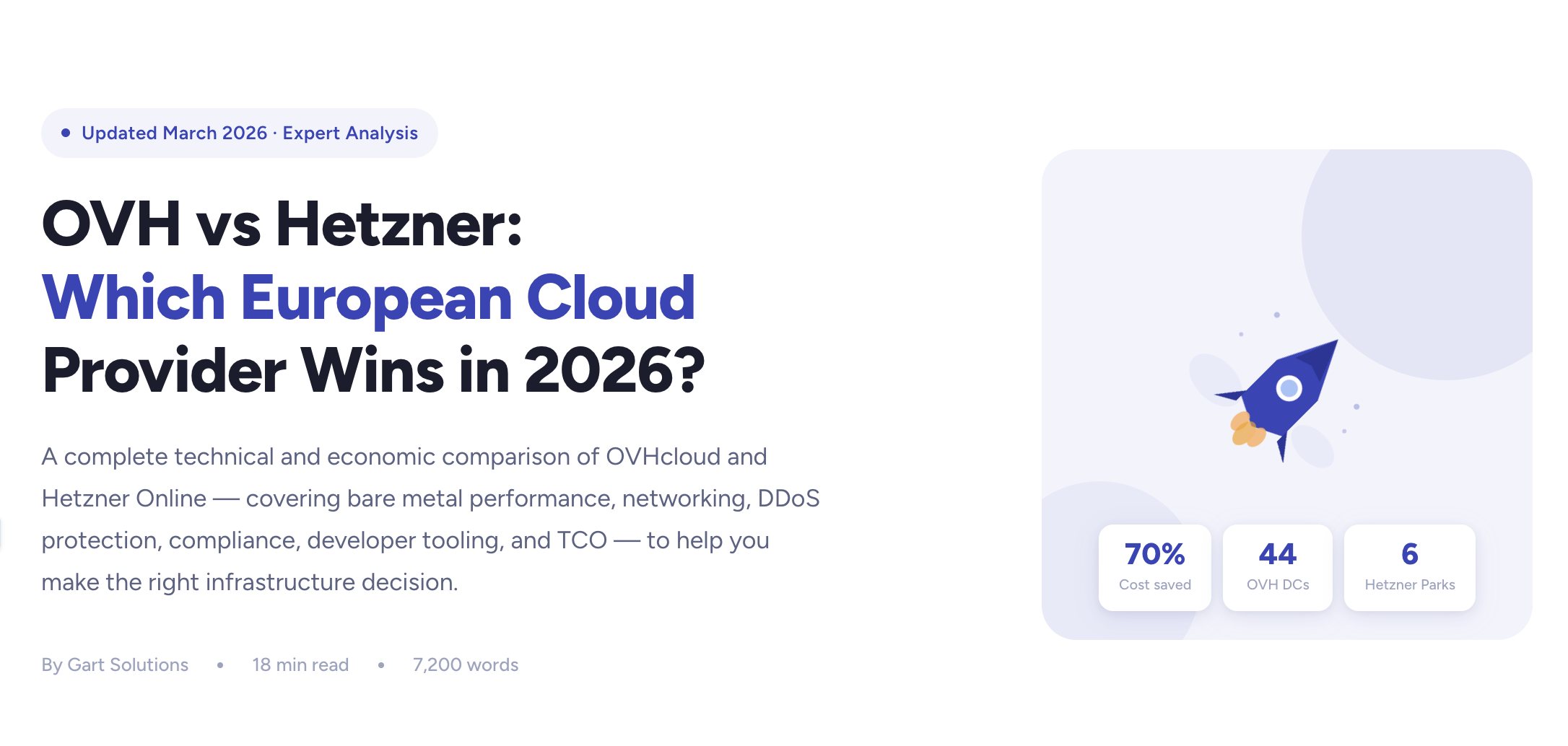
A complete technical and economic comparison of OVHcloud and Hetzner — covering bare metal performance, networking, DDoS protection, compliance, developer tooling, and TCO — to help you make the right infrastructure decision.
Quick Scorecard: OVH vs. Hetzner
Why the OVH vs Hetzner Decision Matters More Than Ever in 2026
The European cloud market has undergone a fundamental shift. What began as a cost-cutting exercise has evolved into a strategic sovereignty play — and at the center of it sit two providers that have come to define the independent cloud category: OVHcloud and Hetzner Online.
For enterprise architects and CTOs evaluating alternatives to AWS, Azure, or GCP, the OVH vs Hetzner comparison is not a question of “budget vs premium.” Both are serious, production-grade infrastructure providers used by tens of thousands of businesses across Europe and globally. The real question is architectural alignment: which provider’s philosophy, capabilities, and trade-offs best match your organization’s specific needs?
In 2026, the “cloud repatriation” trend has accelerated significantly. Organizations migrating from hyperscale environments to European cloud providers are reporting cost reductions between 70% and 90% on equivalent workloads. The primary drivers are not just price — they are egress economics, data sovereignty requirements, performance predictability, and the growing recognition that paying the AWS “cloud tax” is a strategic liability, not a necessary cost of doing business.
This guide provides an exhaustive, technically grounded analysis of both providers across every dimension that matters: physical infrastructure and geographic coverage, bare metal hardware and SLAs, private networking architecture, DDoS protection and compliance certifications, cloud API maturity, developer tooling, total cost of ownership, and practical migration strategy.
Who this analysis is for
This article is written for technical decision-makers — CTOs, Lead Engineers, and senior DevOps professionals — evaluating a migration from hyperscale cloud or on-premises infrastructure to European providers. It goes considerably deeper than surface-level price comparisons.
Global Footprint and Data Center Architecture
The most fundamental difference between OVHcloud and Hetzner begins not in their pricing catalogs or feature lists, but at the physical layer — in how each company conceptualizes data center geography and infrastructure construction.
OVHcloud: Vertical Integration at Global Scale
OVHcloud, headquartered in Roubaix, France, operates with genuinely global ambitions. Its 44 data centers span four continents — Europe, North America, Asia-Pacific, and Africa — connected by a proprietary 32 Tbps fiber optic backbone that the company owns and operates outright. This is not third-party transit capacity: OVHcloud built and controls the fiber, which translates into measurable performance advantages for multi-region architectures.
The company’s operational philosophy is rooted in deep vertical integration. OVHcloud designs and manufactures its own servers, develops its own proprietary water-cooling system that eliminates traditional air conditioning in most zones, and controls virtually every layer of the supply chain from component procurement to rack deployment. This industrial model enables high component density, superior energy efficiency (reflected in industry-leading PUE ratings), and thermal stability that sustains processor performance under sustained high-load workloads.
Hetzner Online: Concentrated Efficiency as Strategy
Hetzner Online, headquartered in Gunzenhausen, Germany, has deliberately chosen a different path. Rather than spreading infrastructure thin across dozens of markets, Hetzner has built extreme operational density in a small number of carefully selected locations. Its primary data center parks are in Nuremberg and Falkenstein (Germany) and Helsinki (Finland), with cloud instances available in Ashburn, Hillsboro, and Singapore. Bare metal dedicated servers, however, remain a European-only offering.
This concentration is the mechanism behind Hetzner’s remarkable price efficiency. By eliminating the overhead of managing a globally distributed supply chain, Hetzner can offer compute resources at price points that are genuinely difficult for any other provider to match. The trade-off is geographic: organizations requiring dedicated hardware presence in North America or APAC must look to OVHcloud.
Key Architectural Decision Point
If your primary user base is European and you don’t require multi-continent bare metal presence, Hetzner’s geographic concentration is an advantage, not a limitation. If you need dedicated servers in North America or APAC, OVHcloud is the default choice in the European cloud tier.
| Feature | OVHcloud | Hetzner Online | Edge |
|---|---|---|---|
| Total Data Centers | 44 sites, 4 continents | 6 parks (EU-primary) | OVH |
| Dedicated Server Regions | Global (EU, NA, APAC, Africa) | Europe only | OVH |
| Network Backbone | 32 Tbps proprietary fiber | 9.7 Tbps peering / 11.3 Tbps transit | OVH |
| Server Manufacturing | In-house proprietary | Standardized / custom-built | OVH |
| Cooling Technology | Proprietary water-cooling | High-efficiency air cooling | Tie |
| Compliance Certifications | HDS, SecNumCloud, SOC 1&2, ISO multi | GDPR / German data law | OVH (Enterprise) |
| Price Efficiency | Strong | Industry-leading | Hetzner |
| Server Auction | Not available | Available (30–60% discount) | Hetzner |
One feature unique to Hetzner in this tier is its Server Auction marketplace — a platform where decommissioned servers are resold at significant discounts, typically 30–60% below new hardware list prices. Servers are only a few years old, fully tested, and backed by Hetzner’s standard SLA. For development environments, staging clusters, or latency-tolerant batch workloads, this creates a cost entry point with no real equivalent elsewhere in the market.
Dedicated Servers: Hardware Tiers, SLAs, and Benchmarks
Bare metal servers — physical machines with no hypervisor overhead, no resource sharing, no “noisy neighbor” contention — remain the performance gold standard. Both OVHcloud and Hetzner have built substantial dedicated server portfolios, but from meaningfully different angles.
OVHcloud’s Tiered Range Architecture
OVHcloud organizes dedicated servers into purpose-built ranges, each engineered for a specific reliability tier and workload profile:
| Range | Target Workload | Max RAM | SLA | Private Network |
|---|---|---|---|---|
| Rise | Dev / Small projects | 128 GB | 99.90% | — |
| Advance | SMB, versatile loads | 1 TB | 99.95% | 1–6 Gbps |
| Scale | Complex / resilient infra | 1.5 TB | 99.99% | 6–25 Gbps |
| High-Grade | Critical loads / AI | 2 TB | 99.99% | 10–50 Gbps |
The Scale and High-Grade ranges include enterprise-grade features such as double power supplies with redundant PDU connections, hot-swap NVMe storage, and OVHcloud Link Aggregation (OLA) for fully redundant network connectivity — features that represent a meaningful operational resilience advantage for mission-critical workloads.
Hetzner’s AX and EX Lines: Raw Power at Aggressive Pricing
Hetzner’s dedicated server portfolio emphasizes raw compute density and high-speed NVMe storage at price points that consistently undercut the competition. The AX line (AMD EPYC and Ryzen) and EX line (Intel Xeon and Core) offer impressive hardware at straightforward pricing:
| Line | CPU Focus | Max RAM | SLA | Private Network |
|---|---|---|---|---|
| AX (Ryzen/EPYC) | AMD EPYC / Ryzen 9 | Up to 1 TB+ | 99.9% | vSwitch |
| EX (Xeon/Core) | Intel Core / Xeon | Up to 128 GB+ | 99.9% | vSwitch |
The flagship AX162-R represents the bleeding edge of Hetzner’s value proposition: AMD EPYC 9454P with 96 cores, DDR5 ECC RAM, and NVMe SSDs in RAID — targeting financial modeling, 3D rendering, big data pipelines, and high-performance computing at a fraction of hyperscale pricing.
Head-to-Head: VPS Performance at the Same Price Point
At the cloud/VPS tier, the performance gap is even more striking. At approximately $19.64/month, Hetzner’s CX53 delivers significantly more raw resources than the OVHcloud VPS-3:
| Metric | OVHcloud VPS-3 | Hetzner CX53 | Edge |
|---|---|---|---|
| CPU Cores | 8 vCPU | 16 vCPU | Hetzner |
| RAM | 24 GB | 32 GB | Hetzner |
| Disk | 200 GB NVMe | 320 GB NVMe | Hetzner |
| Network Speed | 1,500 Mbps | 10,000 Mbps | Hetzner |
| Price (approx.) | $19.64/mo | $19.64/mo | Same |
| EU TTFB | — | 38 ms | Hetzner |
| Global Page Load | 1.1 sec | 5.1 sec | OVH (Global CDN) |
“Hetzner consistently wins on raw resource density per dollar. OVHcloud wins when you need global reach, enterprise SLAs, or multi-region private networking — the comparison depends entirely on what you’re optimizing for.”
The global page load divergence is instructive: OVHcloud’s 32 Tbps backbone delivers dramatically better cross-continental latency (1.1s vs 5.1s in real-world tests). But for organizations with primarily European users, Hetzner’s 38ms TTFB is exceptional — and difficult to beat at any price point.
vRack vs. vSwitch: Private Networking Deep Dive
Private networking is a primary architectural divergence between the two providers — and for organizations building multi-server or multi-region infrastructure, this comparison deserves careful attention.
OVHcloud vRack: Multi-DC Private Fabric
OVHcloud’s vRack (Virtual Rack) technology enables customers to group servers across different physical locations — even different data centers — into a single private Layer 2 switch. This creates isolated networks that span multiple OVH facilities, enabling disaster recovery, cross-DC load balancing, and private inter-service communication that is fully transparent to the public internet.
For organizations running Proxmox, VMware, or complex virtualization stacks across multiple OVH regions, the vRack is typically the preferred choice. Its “transparent” bridging behavior simplifies VM migration and failover considerably. The primary drawback is limited native IPv6 routing within the vRack environment, which remains a documented friction point for IPv6-first architectures.
Hetzner vSwitch: Cost-Effective but Configuration-Heavy
Hetzner’s vSwitch connects dedicated servers and cloud instances within a data center park using IEEE 802.1Q tagged VLANs. It is cost-effective — free for cloud instances, with a setup fee for dedicated servers — but requires significantly more manual configuration at the operating system level.
In practice, Hetzner vSwitch deployments require engineers to create persistent Netplan or systemd-networkd configurations to handle VLAN tagging, and historical reports cite occasional ARP discovery latency and VM migration issues. For teams with strong Linux networking expertise, this is manageable. For teams expecting managed network infrastructure, it represents meaningful operational overhead.
| Aspect | OVHcloud vRack | Hetzner vSwitch | Edge |
|---|---|---|---|
| Technology | Virtual Switch / L2 Isolated | Tagged VLAN (IEEE 802.1Q) | OVH |
| Multi-Region | Natively supported | Limited / Cloud-specific | OVH |
| IPv6 Support | Limited routing in vRack | Supported natively | Hetzner |
| Complexity | Moderate (managed via panel) | High (manual OS config required) | OVH |
| Cost | Included in most ranges | Free (Cloud) / Setup fee (Dedi) | Context |
| Max Bandwidth | Up to 50 Gbps (High-Grade) | vSwitch-limited | OVH |
DDoS Protection, Certifications, and Regulatory Posture
In the 2026 threat landscape, infrastructure security is not an afterthought — it is a primary selection criterion. The two providers differ significantly in their DDoS mitigation maturity and compliance certification portfolios.
OVHcloud VAC: Multi-Terabit DDoS Mitigation
OVHcloud’s VAC (Vacuum) anti-DDoS system is included at no additional cost with all services and provides multi-terabit mitigation capacity. The system uses a sophisticated scrubbing architecture: malicious traffic is identified at the network edge, siphoned into dedicated scrubbing centers, cleaned, and only the verified legitimate traffic is forwarded to the customer’s server.
This architecture means that even during large volumetric attacks, customer services remain available. OVHcloud does not “sinkhole” attacked IPs as a standard mitigation response — a critical differentiator for services where any downtime is commercially unacceptable.
Hetzner DDoS Protection: Effective but Limited
Hetzner provides standard DDoS protection that handles the majority of common attack vectors effectively. However, under sustained or sophisticated attacks, Hetzner has been documented to employ “sinkholing” — dropping all traffic to a targeted IP address to protect the broader network. This protects Hetzner’s infrastructure, but results in customer downtime for the duration of the attack.
As a consequence, many production deployments on Hetzner integrate third-party protection layers — Cloudflare, NeoProtect, or similar services — as a mandatory architectural component for any latency-sensitive or commercially critical endpoint.
Important for High-Risk Workloads
If your application is a likely DDoS target (gaming servers, financial services, public-facing APIs with high traffic), OVHcloud’s VAC system provides substantially stronger out-of-the-box protection than Hetzner’s standard offering. Factor in the cost of third-party DDoS services when comparing TCO.
Compliance and Regulatory Certifications
For organizations in regulated industries — healthcare, fintech, public sector, or any entity processing sensitive EU data — the compliance certification comparison is arguably the most decisive factor in the OVH vs Hetzner decision:
OVHcloud Certifications
Multi-Sector Enterprise Compliance- ISO/IEC 27001, 27017, 27018 Information security management
- SOC 1 & SOC 2 Type II Financial controls and security
- HDS Health Data Hosting (EU healthcare)
- SecNumCloud French public sector cloud qualification
- PCI DSS Payment card industry compliance
Hetzner Certifications
GDPR-First Privacy Compliance- Full GDPR Compliance Native adherence across all EU data centers
- BDSG Adherence German Federal Data Protection Act compliance
- German Data Privacy Operating under the world’s strictest frameworks
- ISO 27001 Certified data center operations
For general commercial applications, Hetzner’s GDPR compliance is fully adequate. For healthcare organizations, financial institutions, or public sector entities with contractual or regulatory requirements for specific certifications, OVHcloud is typically the only viable European option outside hyperscale clouds.
Thinking About Moving to OVH or Hetzner? Start with a Free Audit.
Gart Solutions has helped dozens of companies migrate from AWS, Azure, and on-premises environments to OVHcloud and Hetzner — cutting infrastructure costs by 70–90% with zero unplanned downtime. Our certified DevOps engineers handle the entire transition: architecture design, data migration, Terraform automation, and post-migration hardening.
Public Cloud Instances, Managed Services, and API Maturity
Beyond bare metal, both providers have built public cloud offerings — managed virtualized instances with API-driven provisioning and scaling. The maturity and philosophy of these cloud products differ in ways that significantly impact operational model.
OVHcloud Public Cloud: OpenStack-Based with Metal Instances
OVHcloud’s Public Cloud is built on OpenStack, the open-source cloud infrastructure platform. This provides genuine vendor portability — workloads can theoretically be migrated to any other OpenStack-based cloud without re-architecting. OVHcloud also offers unique “Metal Instances” — dedicated physical hardware provisioned through the same cloud API, delivering bare metal performance with cloud-speed deployment (minutes, not hours).
The managed service portfolio includes OVH Managed Kubernetes, managed databases (MySQL, PostgreSQL, Redis, Kafka), and fully API-integrated S3-compatible object storage. This breadth makes OVHcloud viable as a primary cloud provider for complex, multi-service architectures.
Hetzner Cloud: Developer-First Simplicity
Hetzner Cloud has built its reputation on exceptional developer experience. The management console is consistently praised for its clarity, the API is well-documented with real-world examples, and provisioning is fast. The CX (shared vCPU) and CCX (dedicated vCPU) series provide a clean tiered approach to compute resources.
The managed service catalog is leaner than OVHcloud’s — MySQL and PostgreSQL managed databases, load balancers, and S3-compatible storage — but Hetzner’s S3 still requires manual credential management outside the API, a friction point for teams building fully automated infrastructure-as-code pipelines.
| Tooling | OVHcloud | Hetzner Online | Edge |
|---|---|---|---|
| Terraform Provider | Multiple (OVH, OpenStack, AWS) | Single (Hetzner Cloud) | Hetzner (Simpler) |
| Managed Kubernetes | OVH Managed Kubernetes | Third-party required | OVH |
| API Documentation | Extensive / manual credential gen | Thorough / clear examples | Hetzner |
| Managed Databases | MySQL, PostgreSQL, Redis, Kafka | MySQL, PostgreSQL | OVH |
| S3 Object Storage | Fully API integrated | Manual credential gen required | OVH |
| Cloud Console UX | Complex / feature-rich | Intuitive / developer-friendly | Hetzner |
| Metal Instances | Available (bare metal via cloud API) | Not available | OVH |
The Terraform experience is a nuanced point: OVHcloud’s broader service catalog means that fully automated infrastructure deployment requires managing multiple Terraform providers simultaneously (the OVH provider, the OpenStack provider, and sometimes the AWS provider for S3-compatible storage). This creates a “messy” IaC experience that Hetzner’s single, well-maintained provider avoids entirely.
The Real Economics: OVH vs Hetzner vs AWS
Cost is ultimately what has driven the explosive growth of both OVHcloud and Hetzner as primary alternatives to hyperscale providers. But the comparison is more nuanced than a simple monthly rate comparison — the structure of pricing matters as much as the absolute numbers.
The Egress Tax: The Hidden Cost That Changes Everything
The most significant pricing structural difference is egress fees. AWS charges per-gigabyte for outbound data transfer — a fee that scales directly with your application’s success. A media streaming platform, a software distribution service, or any download-heavy application faces a de facto “growth penalty” on AWS that doesn’t exist on European providers.
Bandwidth & Egress Costs
Unmetered bandwidth included on the vast majority of bare metal server plans. No egress billing for outbound traffic.
20 TB of outbound traffic included per instance per month. Nominal fees thereafter — a small fraction of AWS pricing.
Per-GB egress fees that typically represent 15–25% of total cloud spend for data-intensive applications.
SaaS Infrastructure Case Study: AWS vs European Cloud
A representative SaaS infrastructure — 6 application servers, one large database, one load balancer, typical egress volume — illustrates the economic magnitude of the decision:
| Component | AWS Monthly | Hetzner / OVH Equivalent | Saving |
|---|---|---|---|
| Compute (6 nodes) | $1,200 | $280 | 77% |
| Managed Database | $850 | $115 | 86% |
| Load Balancer | $180 | $15–45 | 75–92% |
| Data Egress (est.) | $650 | Included / flat-rate | 100% |
| Total Monthly | $4,200 | $410–$1,150 | 73–90% |
Real-World Migration Results
A jewelry manufacturer migrating from Azure to European cloud with Gart Solutions’ guidance achieved significant monthly cost reductions while improving performance. A fintech company migrating to OVHcloud gained enterprise compliance certifications previously inaccessible at their budget level.
OVH vs Hetzner: Head-to-Head Pricing Philosophy
Between the two European providers, Hetzner typically offers lower absolute prices for equivalent compute resources — often 20–40% cheaper than comparable OVHcloud configurations. However, OVHcloud’s higher price tier includes features that have real operational value: enterprise SLAs (99.99% vs 99.9%), redundant power systems, multi-region private networking, and included DDoS protection with more sophisticated mitigation.
The TCO calculation must account for the cost of compensating for missing features. A Hetzner deployment that requires third-party DDoS protection, a separate CDN for global reach, and additional engineering time for vSwitch configuration may end up costing more than a comparable OVHcloud deployment in total operational cost — even if the server line items are lower.
How to Migrate to OVH or Hetzner Without Downtime
Understanding which provider to choose is the strategic decision. Actually migrating to it — safely, without data loss, without extended downtime, without breaking dependent integrations — is the operational challenge. This is where the difference between a successful cloud repatriation and a costly failure is made.
The 6 R’s Migration Framework
Migrations don’t follow a single template. The appropriate strategy depends on the application’s architecture, data sensitivity, and acceptable downtime window. The 6 R’s model provides a decision framework:
The 6 Rs of Cloud Migration
Move existing VMs or containers with minimal changes. Fastest approach, lowest risk for stateless applications.
Minor architectural optimizations during migration — e.g., switching from self-managed to managed database.
Moving from a custom solution to a SaaS offering available on the new provider.
Redesigning application architecture to leverage new provider capabilities — higher effort, higher long-term value.
Identifying and decommissioning unused or redundant services during migration.
Keeping specific workloads on current infrastructure that are not yet migration candidates.
Critical Data Migration Techniques
For stateful applications, data migration is the most sensitive phase. Three techniques are particularly important:
Dual-Write Synchronization: Before cutover, configure the application to write simultaneously to both old and new databases. This eliminates data loss risk during the transition window and allows the new environment to be fully validated under real traffic conditions before DNS or IP failover.
Bring Your Own IP (BYOIP): Both OVHcloud and Hetzner support BYOIP — migrating your existing public IP address blocks to the new provider. This preserves IP reputation (critical for email delivery and fraud scoring systems), maintains whitelisted integrations without reconfiguration, and enables a seamless cutover that is invisible to upstream partners.
Staged Traffic Migration: Rather than a single cutover event, route a gradually increasing percentage of traffic to the new environment — 5%, 25%, 50%, 100% — with monitoring at each stage. Automated rollback triggers in the load balancer allow instant recovery if anomalies are detected.
Post-Migration Hardening
Migration is not the end of the project — it is the beginning of the operational phase. Post-migration hardening typically includes:
- ✓Right-sizing VMs and bare metal instances based on actual production load profiles (over-provisioned resources are a common source of unnecessary cost)
- ✓Implementing observability stack: Prometheus metrics, Grafana dashboards, alerting rules calibrated to the new environment’s baseline
- ✓Quarterly disaster recovery tests to validate that backup restoration and failover procedures work correctly in the self-managed bare metal context
- ✓CI/CD pipeline optimization for the new infrastructure, including Terraform state management and Ansible playbook validation
Gart Solutions: Your Dedicated Migration Partner for OVH and Hetzner
The economics of migrating from AWS to OVH or Hetzner are compelling. The technical execution requires expertise. Gart Solutions has developed a rigorous 6-stage migration framework used across healthcare, fintech, e-commerce, and green tech organizations — eliminating the risk of downtime, data corruption, and networking misconfigurations.
Define technical challenges, business objectives, and projected ROI.
Map dependencies, identify quick wins, and detect hidden infrastructure risks.
Collaborative design of milestones, security protocols, and target architecture.
Terraform/Ansible IaC deployment, Docker/Kubernetes containerization, zero-downtime cutover.
Ensure your internal team owns and understands the new environment.
Proactive incident response, performance tuning, and quarterly DR testing.
OVH vs Hetzner: Which Provider Should You Choose?
After a comprehensive analysis across infrastructure, performance, networking, security, compliance, developer tooling, and economics, the verdict is not a binary winner — it is a clear decision framework based on organizational profile.
The Enterprise Choice
Choose OVHcloud when you need:- Global dedicated server presence (NA, APAC, Africa)
- Multi-DC private networking via vRack
- 99.99% SLA on critical infrastructure
- HDS, SecNumCloud, SOC 2 certifications
- Sophisticated multi-terabit DDoS protection (VAC)
- Managed Kubernetes and full service catalog
- Bare metal provisioned through cloud API
The Developer / Efficiency Choice
Choose Hetzner when you need:- Maximum compute-per-euro for European workloads
- Strong internal DevOps / Linux networking expertise
- Simple, clean developer experience and API
- Access to Server Auction for budget environments
- AMD EPYC high-core-count workloads at low cost
- No complex compliance certification requirements
When to Use Both Together
A growing number of sophisticated architectures use both providers in complementary roles: Hetzner for high-volume European compute (application servers, data processing, CI/CD workers) and OVHcloud for network-critical components that benefit from vRack, multi-region private connectivity, or VAC DDoS protection. The providers are not mutually exclusive — they can form a genuinely powerful hybrid European cloud stack.
“The OVH vs Hetzner decision is not a permanent commitment — it is an architectural choice that can evolve as your organization scales. What matters is choosing the right tool for your current requirements while maintaining the architectural flexibility to adapt.”
The Migration Question: Going It Alone vs. Expert Guidance
The economics of migrating from hyperscale cloud to OVHcloud or Hetzner are clear and compelling. The technical execution is where organizations encounter unexpected complexity: database state management, network topology replication, IP reputation preservation, zero-downtime cutover sequencing, and post-migration observability calibration all present real risks that are not visible from a spreadsheet comparison.
Organizations with strong internal infrastructure engineering teams and prior experience with bare metal environments may execute migrations successfully. Organizations that lack this specific expertise — or that cannot afford extended unplanned downtime — benefit substantially from partnering with specialists who have navigated these exact scenarios dozens of times.
This is precisely the space that Gart Solutions occupies. With over 15 years of infrastructure expertise across healthcare, fintech, e-commerce, and green tech, Gart operates not as a generic outsourcing vendor but as a technical extension of your team — focused on knowledge transfer, self-sufficiency, and measurable outcomes. Clients typically achieve migration investment payback within three months of going live.
See how we can help to overcome your challenges