Why the most complex software problems are not technical at all — and how DDD gives your engineering teams a shared language, clear boundaries, and the architecture to scale without chaos.
The problem hiding in plain sight
In my years architecting cloud platforms and leading digital transformation programs across finance, logistics, and SaaS, I have observed the same paradox repeatedly: the most expensive failures in software engineering are not caused by choosing the wrong database, the wrong cloud provider, or the wrong programming language. They are caused by a failure to understand the business well enough to model it correctly in software.
A team builds a microservices platform. It deploys. It scales. And then, six months later, engineers are afraid to touch the “Order” service because nobody can agree on what “Order” actually means across the system. The word appears in five contexts, and in each one it means something slightly different. No single developer holds the complete picture in their head. Releases slow down. Bugs multiply. The architecture — technically sound on paper — has become a liability.
Domain-Driven Design (DDD) is the discipline that prevents this. It is not a framework. It is not a library you install. It is a methodology — a way of thinking, collaborating, and structuring code — that keeps your software aligned with the business domain it was built to serve, even as both evolve over years.
Eric Evans introduced DDD in his landmark 2003 work “Domain-Driven Design: Tackling Complexity in the Heart of Software” (colloquially known as the “Blue Book”). Over two decades later, it remains the most rigorous answer we have to the question: how do we build software that stays true to the business as complexity scales?
of enterprise software projects fail to deliver expected business value
Year Eric Evans published the foundational DDD “Blue Book”
years of industrial adoption across banking, logistics, and cloud platforms
The philosophy: domain first, always
Traditional software architecture tends to be technology-first. Engineers start with the database schema, design API endpoints around CRUD operations, and treat business logic as a thin layer on top. The result is what practitioners call an anemic domain model — objects that hold data but contain no real behavior, with all the business logic scattered across service classes and transaction scripts.
Domain-Driven Design reverses this priority entirely. The domain — the specific subject area your business operates in — is the primary source of truth. Every architectural decision flows from a deep, continuous engagement with that domain. Evans called this “Knowledge Crunching”: a sustained process of learning, questioning, and distillation between developers and domain experts to uncover the Deep Model, the set of essential abstractions that remain stable as surface-level features change.
“The heart of software is its ability to solve domain-related problems for its users. All other features, vital as they may be, support this basic purpose.”
— Eric Evans, Domain-Driven Design (2003)
This is not a one-time workshop. Knowledge crunching is ongoing. The domain evolves as the business evolves. Markets shift, regulations change, new competitors redefine customer expectations. A DDD-aligned organization treats its domain model as a living artifact — constantly refined, never frozen.
What emerges from this process is a Shared Model: not a comprehensive encyclopaedia of the business, but a practical, precise abstraction designed to solve the specific problems the software must address. The key insight is that models are never perfect — they are tools, and like all tools, they must be chosen and sharpened for the task at hand.
Strategic design: governing large-scale architecture
When organizations first encounter DDD, they often fixate on the tactical patterns — entities, aggregates, repositories. But experienced practitioners universally agree: strategic design is where the real value lies. It addresses how to decompose a large, complex system into coherent, independently manageable parts, and how those parts should relate to one another.
Bounded contexts: the cornerstone of strategic domain-driven design
The Bounded Context is the central pattern of strategic design. It defines a specific boundary — conceptual, linguistic, and transactional — within which a particular domain model is consistently valid. Inside this boundary, every term has a precise, unambiguous meaning. Step outside, and the same terms may mean something entirely different.
Consider a mid-size e-commerce platform. The word “Product” appears across the entire system, but its meaning varies by context. In the Inventory context, a product has a weight, dimensions, and a warehouse location. In the Billing context, it has a price, tax class, and discount rules. In the Marketing context, it has descriptions, images, and review scores. Each of these is a legitimate, internally consistent model of “Product” — just optimized for a different purpose.
Forcing a single “Product” model to serve all three contexts simultaneously produces an object so overloaded with conditional logic and nullable fields that it becomes unmaintainable. The Bounded Context pattern says: resist that temptation. Let each context own its own model, optimized for its own purpose.
In modern cloud architectures, a Bounded Context is often the natural candidate for an independent microservice — with its own deployment pipeline, data store, and team ownership.
Ubiquitous language: the shared vocabulary of precision
Alongside the Bounded Context, Domain-Driven Design mandates the development of a Ubiquitous Language (UL): a shared vocabulary built collaboratively by developers and domain experts and used pervasively in every form of communication, including code, tests, documentation, meetings, and user stories.
The UL is not “business jargon” versus “technical jargon” — it is a third language, forged in collaboration, that both sides speak fluently. When a domain expert describes a change, the developer maps it directly to specific classes, methods, and events without a mental translation step. This alignment dramatically reduces misunderstandings, prevents bugs introduced through misinterpretation, and makes codebases readable to people who understand the business.
Crucially, the UL is strictly bounded by its context. The “Claim” in an Insurance Claims Processing context is not the same as the “Claim” in a Marketing Attribution context. Both are legitimate uses of the word, but they are kept separate, with clean boundaries between them.
Context mapping: understanding who depends on whom
In any system of meaningful complexity, Bounded Contexts do not exist in isolation. They interact, share data, and trigger each other’s behaviors. Context Mapping is the strategic tool used to document and analyze these relationships, surfacing organizational dynamics, technical dependencies, and potential integration risks.
| Pattern | Relationship | When to Use |
|---|---|---|
| Partnership | Symmetric / Mutually dependent | Two teams must coordinate closely; success is shared. |
| Shared Kernel | Symmetric / Collaborative | Small shared subset of the model; changes require agreement. |
| Customer-Supplier | Asymmetric / Upstream-Downstream | Supplier tries to meet customer needs; supplier holds power. |
| Conformist | Asymmetric / Downstream conforms | Downstream has no influence; adopts upstream model directly. |
| Anti-Corruption Layer | Asymmetric / Translation boundary | Downstream isolates itself from a poorly-designed upstream. |
| Open Host Service | Asymmetric / Published API | Upstream offers a stable, documented public API for consumers. |
| Published Language | Asymmetric / Shared format | Well-documented exchange format, often paired with OHS. |
| Separate Ways | No relationship | Integration costs exceed benefits; contexts evolve independently. |
| Big Ball of Mud | Unstructured | Legacy areas without clear boundaries; approach via ACL. |
What makes context mapping particularly powerful is that it makes organizational politics and team dynamics explicit architectural concerns. The difference between a Customer-Supplier relationship and a Partnership is not just technical — it determines whether two teams need weekly syncs or quarterly alignment calls. Architecture and team topology are deeply intertwined.
Tactical design: building blocks of the domain model
Tactical design provides the implementation patterns — the concrete building blocks used to express the domain model in code. These patterns ensure that business rules are enforced at the right level of the system, that persistence concerns are cleanly separated from domain logic, and that the codebase is structured to evolve safely.
Entities vs. value objects
The most fundamental distinction in tactical Domain-Driven Design is between Entities and Value Objects.
An Entity is a domain object defined primarily by its identity. A Customer entity remains the same customer even if they change their name, email address, and phone number — what makes them the same customer is their unique identifier. Entities have lifecycles; they are created, they mutate, and they may eventually be deleted or archived.
A Value Object is defined entirely by its attributes. It has no identity. Two Money objects representing €50 are identical and interchangeable — there is no meaningful distinction between one €50 and another €50. Value objects are immutable: operations on them return new instances rather than modifying existing ones. This makes them inherently thread-safe and side-effect-free, which is particularly valuable in distributed systems.
Entity
Defined by identity. Mutable over time. Examples: Customer, Order, Account.
Value Object
Defined by attributes. Immutable. Examples: Money, Address, DateRange.
Aggregate
A cluster of entities/VOs with one root. Enforces transactional invariants.
Domain Event
Something significant that happened. Past tense. Enables eventual consistency.
Aggregates: the unit of transactional consistency
An Aggregate is a cluster of related entities and value objects treated as a single unit for the purposes of data changes. Every aggregate has exactly one Aggregate Root — an entity with global identity that acts as the sole gateway to the aggregate. External objects may hold references to the root, never to internal members of the aggregate.
The aggregate root is responsible for maintaining invariants: business rules that must remain true whenever any state within the aggregate changes. For example, an Order aggregate might enforce that an item cannot be added once the order is in “Shipped” status, or that the total must always equal the sum of its line items. These rules are enforced at the aggregate boundary, ensuring consistency without needing distributed transactions.
A crucial design rule: aggregates should be small. An aggregate that encompasses dozens of entities becomes a bottleneck — it requires locks, creates contention, and is difficult to reason about. The canonical advice is that a microservice should be no smaller than a single aggregate and no larger than a single Bounded Context.
Repositories and domain services
Repositories provide a clean abstraction for persisting and retrieving aggregates. They present the illusion of an in-memory collection — your domain code simply asks the repository for an Order by its ID, without knowing whether the data lives in PostgreSQL, MongoDB, or a remote API. This persistence-agnosticism is essential for testability: unit tests use in-memory repositories, while integration tests point to real databases.
Domain Services capture logic that does not naturally belong to any single entity or value object. If calculating a quote requires coordinating across a Customer, a Product catalog, and a RegionPricingPolicy, none of those individual objects is the right home for that logic. A stateless QuoteService in the domain layer is the appropriate abstraction — it encapsulates the coordination without leaking infrastructure concerns into the model.
Event storming: discovering the domain together
One of the persistent challenges in Domain-Driven Design is the “Knowledge Crunching” problem — how do you extract complex domain knowledge from business experts efficiently enough to model it correctly? Traditional requirements-gathering (workshops, user stories, documentation) is often too slow and too shallow.
Event Storming, created by Alberto Brandolini, is the answer the Domain-Driven Design community converged on. It is a large-format collaborative workshop that brings domain experts and developers together around a long paper roll on the wall, using color-coded sticky notes to build a shared understanding of the domain through its events.
Event storming notation
The power of Event Storming lies in its accessible notation. Anyone in the room can participate — no UML knowledge required. Here is the standard color scheme:
Three levels of granularity
Big Picture Event Storming
Explores an entire domain or business unit. Identifies bottlenecks (Hotspots) and candidate Bounded Contexts. Breadth over depth.
Process Level Event Storming
Details a specific business process end-to-end. Introduces the Command → Policy → Event grammar. Surfaces hidden requirements and edge cases.
Software Design Event Storming
Maps events and commands to aggregates and Bounded Contexts. Produces the design input for implementation sprints.
In practice, a well-run Event Storming session can accomplish in one or two days what months of written requirements documents cannot: a shared, visual understanding of the domain that everyone in the room — business and technical — genuinely owns.
Architectural synergy: DDD, hexagonal, and microservices
Domain-Driven Design does not prescribe a specific technical architecture, but it is profoundly synergistic with two patterns that have become central to modern cloud-native development: Hexagonal Architecture and Microservices.
Hexagonal architecture (Ports and Adapters)
Hexagonal architecture, proposed by Alistair Cockburn, places the domain model at the center of the system and isolates it from all external concerns through a set of Ports (interfaces) and Adapters (implementations). At the innermost layer sits the Domain Model — pure business logic, no frameworks, no HTTP, no database drivers. Around it is the Application Service Layer, which orchestrates use cases. On the outside are adapters that translate between the domain’s language and external protocols: REST controllers, Kafka consumers, SQL repositories, SMTP email senders.
This architecture enforces the DDD principle of keeping the domain layer “pure.” You can swap a Postgres repository for a DynamoDB repository without touching a single line of domain logic. You can test your entire domain model in-memory without spinning up a database. The domain remains stable even as the infrastructure evolves.
Microservices: bounded contexts at deployment scale
The relationship between Bounded Contexts and microservices is one of the most consequential design decisions in modern cloud architecture. Strategic DDD is, quite literally, a tool for identifying microservice boundaries. A well-defined Bounded Context — with its own ubiquitous language, clear internal model, and explicit integration points — maps naturally to a service that can be deployed, scaled, and maintained independently.
Vaughn Vernon’s widely-cited rule of thumb holds that a microservice should be no smaller than a single aggregate and no larger than a single Bounded Context. Services smaller than an aggregate require distributed transactions to maintain invariants — a significant complexity cost. Services larger than a Bounded Context mix models and languages, reintroducing the very confusion that DDD is designed to prevent.
Critically, many organizations jump to microservices as a way to force architectural discipline without doing the DDD work first. This is a recipe for a distributed big ball of mud — all the operational complexity of microservices, with none of the clarity of well-defined domain models. The discipline must come first.
Industrial case studies: lessons from the field
Theory is only valuable if it holds under real-world pressure. DDD has been battle-tested across industries and at scale. Here are three patterns of adoption I have seen repeatedly — and the lessons they carry.
SoundCloud: eight years of strangling a monolith
SoundCloud’s migration from a monolithic Ruby on Rails application to a microservices architecture is one of the most honest and detailed public accounts of a large-scale DDD-informed modernization. They used the Strangler Pattern — adopting small, independently deployable services one at a time, slowly replacing the monolith from the inside out.
Key lessons from their journey: telemetry was more reliable than documentation for understanding what the monolith actually did. Undocumented endpoints and unexpected behaviors were discovered through observation, not written specs. Many capabilities that came “for free” in Rails had to be consciously re-implemented in the new services — teams that underestimated this hidden cost suffered significant delays. And the Backend for Frontend (BFF) pattern proved essential for managing the transition boundary between old and new.
Banking and insurance: modeling regulatory complexity
Regulated industries present DDD’s most compelling use case. In banking, DDD enables the decomposition of monolithic core banking systems into focused domain services — fraud detection, payment processing, account management — each with its own model, team, and deployment cadence. The Anti-Corruption Layer pattern is particularly valuable here: legacy core banking systems rarely have clean APIs, and an ACL prevents their messy data models from contaminating the modern domain layer.
In insurance, DDD brings clarity to the inherently complex web of underwriting rules, risk assessment models, and claims workflows. Bounded Contexts such as “Policy Management,” “Claims Processing,” and “Reinsurance” ensure that regulatory constraints are explicitly modeled in the domain — not scattered across service layers — and that compliance changes can be made with surgical precision rather than system-wide fear.
The Airbnb lesson: domain-first, not technology-first
Airbnb’s earliest growth inflection point came not from a technical innovation but from a domain insight. The team identified that the primary bottleneck to bookings was not the platform’s functionality — it was the quality of listing photographs. Hosts were posting blurry, poorly-lit images of their spaces. Airbnb’s response was deliberately non-technical: they traveled to New York and professionally photographed listings themselves.
Bookings grew dramatically. This is a DDD case study without the vocabulary: the team performed “knowledge crunching” on their domain, discovered the real constraint, and addressed it at the domain level before reaching for a technological solution. The principle translates directly to software architecture: deeply understand what the domain actually needs before designing the system.
Critical perspectives: where DDD can fail
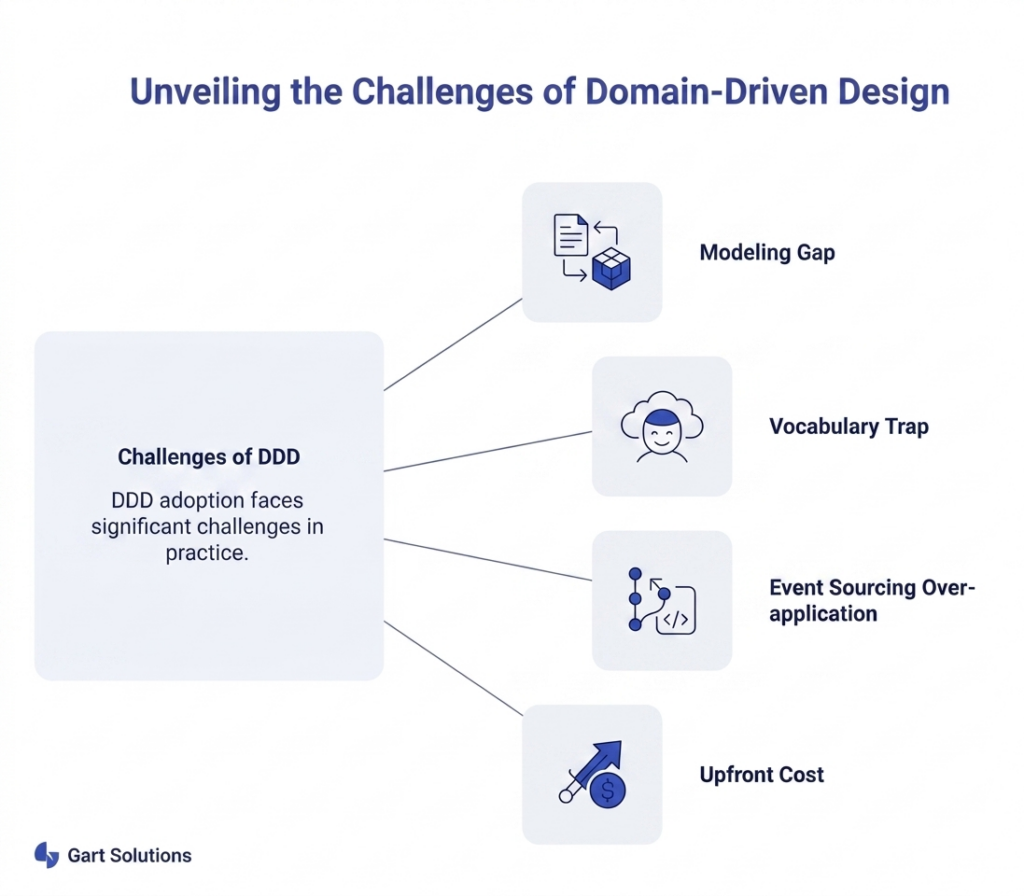
I believe strongly in DDD — but intellectual honesty requires acknowledging its genuine challenges. Teams that adopt DDD without understanding these failure modes are likely to replicate them.
The modeling gap. DDD provides philosophy and patterns, but relatively few formal heuristics for distinguishing a good model from a flawed one. There is no equivalent of cyclomatic complexity for Bounded Contexts. This places significant weight on the practitioner’s experience and judgment — which makes the outcome highly variable across teams and organizations.
The vocabulary trap. Organizations sometimes adopt the DDD vocabulary — “bounded contexts,” “ubiquitous language,” “aggregates” — without genuinely changing their development practices. The language becomes a signaling mechanism rather than a disciplined methodology. What distinguishes real DDD adoption from theatrical DDD adoption is the sustained investment in knowledge crunching and the willingness to refactor models as understanding deepens.
Event sourcing over-application. Event sourcing is a powerful pattern, but it is not synonymous with DDD. Some teams — seduced by the elegance of event-sourced aggregates — apply it universally, including to contexts where it introduces significant operational complexity with minimal benefit. The “event junkie” archetype is real, and costly.
The upfront cost. DDD requires meaningful investment before a single line of production code is written. Event Storming workshops, ubiquitous language cultivation, context map design — all of this takes time and money. For startups or small teams under rapid delivery pressure, the investment can feel prohibitive. The counterpoint is that the cost of not doing DDD — architectural decay, rework, “big ball of mud” — is paid anyway, just later and at higher interest.
The future of DDD: AI, data mesh, and beyond
As we move through the mid-2020s, DDD is evolving in response to two major forces: the rise of AI as a design and development tool, and the emergence of Data Mesh as a paradigm for distributed data governance.
Data mesh: DDD for data
Data Mesh, pioneered by Zhamak Dehghani, applies DDD’s strategic principles to data architecture. Its core proposition is that data should be owned by the Bounded Context that generates it, managed as a product, and made discoverable and trustworthy for consumers across the organization. This is, in essence, extending the Bounded Context principle from application logic to data ownership.
For organizations already practicing Domain-Driven Design, the transition to Data Mesh is conceptually natural. The same boundaries that define your microservices become the boundaries of your data domains. The same teams that own the Order service own the Order data product. The federated governance model maps to the context mapping relationships you have already defined.
AI-accelerated domain modeling
At DDD Europe 2025 and Explore DDD, a significant portion of the conversation has shifted to the role of Large Language Models in supporting domain modeling. There is genuine excitement about using LLMs to analyze legacy codebases and suggest candidate domain models, to generate ubiquitous language documentation from existing code, and to assist in Event Storming facilitation by synthesizing patterns across large domain event sets.
The caution — raised by Eric Evans and others — is appropriate: LLMs can “hallucinate” plausible-sounding but incorrect domain concepts. In critical business logic (financial calculations, regulatory compliance, safety systems), AI-suggested models require rigorous human validation. The human domain expert remains essential. AI is a tool for accelerating the knowledge crunching process, not a replacement for it.
At Gart Solutions, we are actively exploring how to integrate AI-assisted analysis into our architecture consulting practice — using LLMs to accelerate the discovery phase while ensuring that final modeling decisions are always grounded in genuine domain expertise.
How to start with Domain-Driven Design: a practitioner’s roadmap
If you are leading an engineering organization and want to introduce DDD thinking, here is the sequence I recommend based on first-hand experience:
Run a Big Picture Event Storming
Bring domain experts and key engineers into a room for one to two days. Map the domain’s events from left to right. Identify Hotspots — areas of confusion, disagreement, or uncertainty. These become your design priorities.
Identify and name your Bounded Contexts
Look at natural clusters of events that share the same domain language. Name them explicitly. Draw the boundaries. This is your Context Map — make it visible and keep it updated.
Develop a Ubiquitous Language for each context
Document the terms that matter within each Bounded Context. Enforce their use in code, in meetings, and in tickets. Refactor code that does not reflect the language.
Design aggregates for consistency, not convenience
Start small. An aggregate should contain only what is needed to enforce its invariants. Use domain events and eventual consistency for cross-aggregate coordination.
Apply Hexagonal Architecture within each context
Isolate the domain model from infrastructure. Define ports (interfaces) for repositories, external services, and event publishers. Implement adapters for each deployment target.
Iterate and refactor continuously
The model is never done. As you learn more about the domain through production behavior or customer feedback — update the model. The investment in DDD pays dividends only if the model stays alive.
Conclusion: architecture is a conversation, not a diagram
Domain-Driven Design has spent over two decades earning its place as the most rigorous framework for managing complexity in software. Its core insight — that the structure of software must reflect the structure of the business — sounds simple. Executing it at scale, under delivery pressure, across large organizations with multiple teams and years of accumulated technical debt, is anything but.
The organizations that get Domain-Driven Design right treat it as an ongoing practice, not a one-time architecture project. They invest in Event Storming not just at the start of a project but whenever significant domain complexity surfaces. They maintain their Context Maps as living documents. They refactor their ubiquitous language when they discover that the words have drifted from the domain reality. And they resist the temptation to let technology drive modeling decisions.
The reward is an architecture that remains coherent, maintainable, and aligned with the business — even as both the technology and the business change around it. In an era of cloud-native microservices, AI-driven applications, and accelerating market change, that alignment is not a luxury. It is a competitive advantage.
Ready to architect for scale?
With 8+ years of cloud architecture experience and 50+ successful projects, we guide you from architectural chaos to clarity — whether breaking a monolith or designing a greenfield platform.
DevOps & Platform
CI/CD, Kubernetes, observability, and SRE practices
Data Architecture
Data Mesh design, lakehouse, and real-time pipelines
AI / ML Engineering
LLM integration, MLOps, and AI-assisted modernization
See how we can help to overcome your challenges