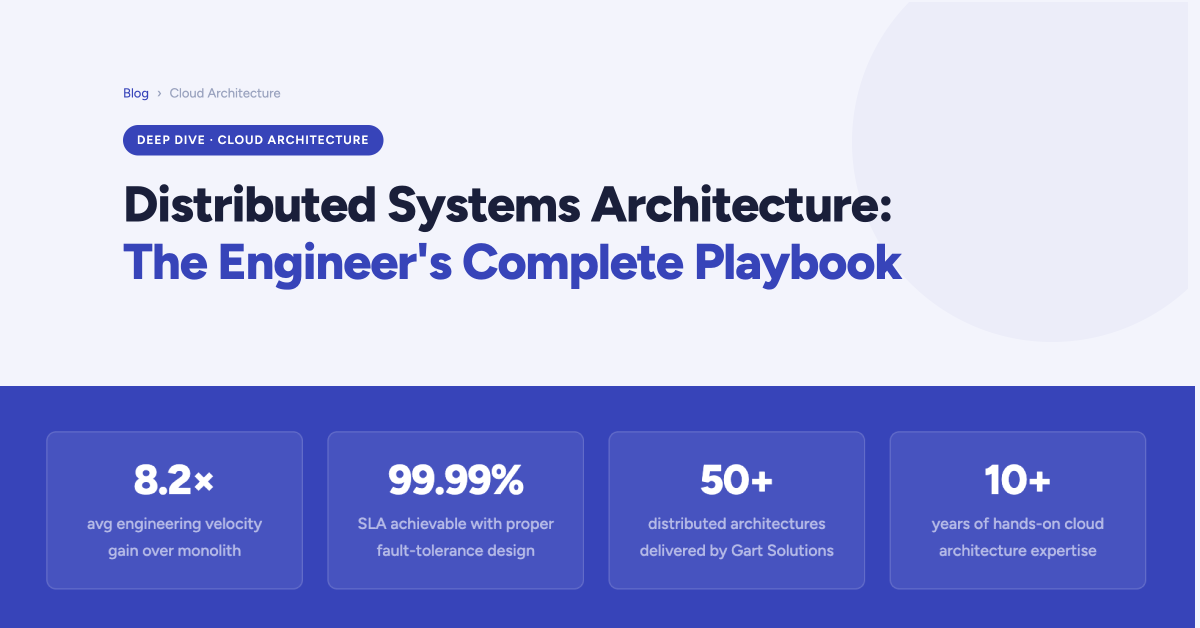
From CAP theorem trade-offs to Raft consensus and production resilience patterns — everything you need to design distributed systems that actually hold up at scale.
Why distributed systems architecture matters now
I’ve spent over a decade designing cloud infrastructure for companies ranging from Series A startups to global enterprises. In that time, one truth has remained constant: the decision of how you architect your distributed system is the most consequential technical choice you will make. Get it right, and you unlock engineering velocity, resilience, and scale that would be impossible with a monolith. Get it wrong, and you trade one set of problems for a far messier one.
The architectural landscape has fundamentally shifted. Modern software applications don’t run on a single server — they span dozens of services, hundreds of nodes, and multiple cloud regions simultaneously. A distributed system is a collection of independent computational nodes — physical servers, virtual machines, or containers — that collaborate over a network to achieve a shared objective while presenting the user with the appearance of a single, unified system.
When I advise clients on distributed systems, I always start with the same question: “What does failure look like for your business?” The answer shapes every technical decision that follows — from your consistency model to your consensus algorithm. There is no universally correct architecture; there is only the right architecture for your constraints.
The primary operational goals of distributed computing are threefold: enhanced scalability, fault tolerance, and performance. By allocating workloads across multiple nodes, systems can leverage collective processing power that no single server can provide. This architectural shift also delivers significant gains in engineering velocity — individual components can be developed and deployed independently, eliminating the coordination overhead that cripples large monolithic codebases.
| Dimension | Centralized Architecture | Distributed Systems Architecture |
|---|---|---|
| Scalability | Limited by a single server’s capacity | Highly scalable — expand by adding nodes |
| Fault tolerance | Single point of failure — the whole system goes down | Resilient — if one node fails, others take over |
| Performance | Becomes a bottleneck under heavy load | Workloads split across nodes for parallel execution |
| Engineering velocity | Slow — coordinating a single codebase is costly | High — independent services deploy independently |
| Operational complexity | Simple to manage | Complex — requires observability investment |
Core principles of distributed systems architecture
Before we dive into the deep technical trade-offs, it’s worth being precise about what characterizes a genuinely distributed architecture versus a system that merely runs on multiple machines.
Concurrency
Multiple machines execute processes simultaneously, improving overall throughput and eliminating serial bottlenecks.
Transparency
Despite underlying complexity, users interact with the system as a single coherent entity — location, migration, and replication are invisible.
Resource sharing
Nodes pool computing power and storage, enabling the system to handle tasks far beyond any single machine’s capacity.
Decentralization
No single control unit — removing the central point of failure that brings traditional architectures to their knees.
CAP, PACELC, and the trade-off you can never escape
Every engineer working on distributed systems architecture must internalize the CAP theorem, not as academic trivia but as a daily design constraint. It posits that a distributed data store can simultaneously provide only two of three guarantees: Consistency, Availability, and Partition Tolerance.
The critical insight is that network partitions — failures in communication between nodes — are an inherent reality in distributed environments. This makes partition tolerance effectively non-negotiable. The real decision, then, is whether your system prioritizes consistency or availability when a partition occurs.
“In real-world systems I’ve built, the choice between CP and AP isn’t made once and forgotten. It’s made at the service level — your payment processor must be CP, your recommendation engine can be AP. The mistake I see most often is applying a single strategy to the entire system.”
Beyond CAP: the PACELC theorem
The CAP theorem’s limitation is that it only speaks to behavior during partitions — rare events. The PACELC theorem extends the framework to normal operations: even when the system is running perfectly, architects must choose between latency and consistency. Ensuring strong consistency requires explicit acknowledgments and network round-trips, which inherently increases latency.
| PACELC Config | During Partition | Normal Operation | Real-world Examples |
|---|---|---|---|
| PA/EL | Prioritizes availability | Prioritizes low latency | DynamoDB (default), Cassandra, ScyllaDB |
| PA/EC | Prioritizes availability | Prioritizes consistency | MongoDB (majority concern) |
| PC/EC | Prioritizes consistency | Prioritizes consistency | Google Spanner, BigTable, ACID-compliant distributed SQL |
| PC/EL | Prioritizes consistency | Prioritizes low latency | Rare; niche use cases only |
Common pitfall
Traditional RDBMS systems prioritize ACID guarantees, choosing consistency over availability. NoSQL systems often adopt BASE philosophy, favoring availability. Neither approach is inherently superior — the decision must align with your business domain’s tolerance for stale data.
Consistency models in distributed systems architecture
Consistency models define how and when data changes become visible across nodes, balancing the needs for data accuracy against system performance. Understanding the full spectrum — not just “strong” vs “eventual” — is essential for production-grade distributed systems architecture.
| Model | Guarantee | Performance Impact | Best Fit |
|---|---|---|---|
| Strong | Every read reflects the most recent write (linearizability) | High latency; reduced availability | Banking, inventory, payment systems |
| Sequential | All nodes agree on operation order, not timing | Moderate latency | Collaborative editing, shared logs |
| Causal | Cause-effect relationships preserved | Low latency for independent ops | Real-time chat, social media feeds |
| Eventual | Replicas converge given no new updates | Minimal latency; maximum availability | CDN caching, like counts |
| Session | Consistent view within a single user session | Targeted latency | E-commerce shopping carts |
A useful mental model: strong consistency is like a single whiteboard in a room — everyone sees the same thing instantly. Eventual consistency is like Wikipedia — any node can be edited, and the truth eventually converges, but there’s a window of divergence. Causal consistency sits between: your reply to a comment always appears after the comment, even if other unrelated edits arrive in a different order for different users.
Data Management in distributed systems architecture
As datasets grow beyond the capacity of a single machine, distributed systems require sophisticated data management techniques. The three core mechanisms are sharding, replication, and consistent hashing — each solving a different dimension of the scaling problem.
Sharding strategies
Sharding partitions a large dataset into smaller, independent segments (shards) typically residing on separate nodes. The success of any sharding implementation hinges entirely on shard key selection — an immutable attribute with high cardinality that determines data placement.
Range sharding
Partitions data based on value ranges (e.g., timestamps, alphabetical IDs). Simple to implement and great for range queries — but creates “hotspot” shards when recent data is disproportionately accessed.
Hash sharding
Applies a hash function to the shard key for uniform distribution, preventing hotspots. The trade-off: range queries become complex as related data scatters across shards.
Geographic sharding
Stores data on nodes closest to users — reduces latency and satisfies data residency requirements. Risky if user population is geographically uneven, leading to load imbalances.
Consistent hashing: scaling without chaos
Traditional hash-based distribution fails badly when nodes are added or removed — it forces a massive rebalancing of nearly all data. Consistent hashing solves this elegantly by mapping both data items and nodes to a circular hash ring. When a new node joins, only the data adjacent to it on the ring needs to move. This technique is foundational for CDNs, distributed caches, and any system requiring minimal disruption during scaling.
Production insight
At Gart Solutions, we’ve seen consistent hashing reduce node-addition rebalancing overhead by over 90% compared to naive modulo-based sharding in high-throughput Kafka and Redis clusters. The circular ring abstraction also makes it straightforward to add virtual nodes for more granular load distribution.
Architectural styles: from microservices to event-driven
Microservices architecture
Microservices decompose a monolith into a collection of small, independent services — each responsible for a specific business capability (payments, user profiles, notifications) with its own dedicated data store. The independence allows different services to use different technologies and scale according to their specific load demands.
The cost of this flexibility is significant: microservices multiply the “failure surface” of the system. An outage in one service can cascade to others if not managed through circuit breakers, bulkheads, and timeouts. Observability investment is non-negotiable — without distributed tracing, debugging production issues becomes a nightmare across dozens of separate log streams.
Event-driven architecture (EDA)
Event-driven architecture decouples producers from consumers by routing state changes through an event bus or stream. This allows services to scale independently and react to data changes in real-time — without either party knowing about the other’s existence.
| EDA Pattern | Description | Strategic Benefit |
|---|---|---|
| CQRS | Separates write operations (commands) from read operations (queries). | Optimizes read and write workloads independently — critical for read-heavy systems. |
| Event sourcing | Stores state changes as immutable events rather than current state snapshots. | Full auditability, temporal querying, and complete state replay for debugging. |
| Change Data Capture | Tracks real-time changes made to a source database. | Enables real-time data pipelines and cross-system synchronization without tight coupling. |
| Saga pattern | Manages distributed transactions through sequences of local transactions and compensating actions. | Data consistency across services without distributed locking overhead. |
Struggling with distributed system complexity?
From architecture design reviews to full-scale cloud migrations, Gart Solutions has helped 50+ companies build resilient, high-performance distributed systems. Our team brings hands-on experience with Kubernetes, Kafka, gRPC, and multi-cloud infrastructure.
Schedule a free architecture reviewOur Expertise
- Architecture Design Review
- Microservices Migration
- Kubernetes & Container Strategy
- Cloud Cost Optimization
- Data Pipeline Engineering
- DevOps & SRE
Distributed consensus: Paxos vs Raft
In distributed environments, nodes must reach agreement (consensus) on shared data or the order of operations despite node failures and network delays. Achieving this requires algorithms that are both safe (only one value is agreed upon) and live (the system eventually makes progress). These two properties are the foundation of every reliable distributed database.
Paxos: the theoretical foundation
The Paxos algorithm, introduced by Leslie Lamport, is the foundational approach to distributed consensus. It uses a quorum-based mechanism with three roles — Proposers (who suggest values), Acceptors (who vote), and Learners (who record decisions) — requiring two full network round-trips per consensus round. While theoretically robust, the original Paxos paper was so ambiguous it led to years of academic debate and became notorious for implementation difficulty.
Raft: the practical alternative
Raft was designed specifically to be more understandable and implementable than Paxos. It operates on a strong leader model, decomposing consensus into three independent sub-problems:
(timeout)
(votes)
(majority)
Raft’s clarity has made it the algorithm of choice for critical infrastructure. It powers etcd (the backbone of Kubernetes), Consul, and CockroachDB. In my experience building production systems, Raft’s debuggability alone — the ability to reason clearly about what the leader is doing — is worth the slightly more constrained design compared to Paxos variants.
| Feature | Paxos | Raft |
|---|---|---|
| Leader model | No dedicated leader; any Proposer can initiate | Strong single leader manages all requests |
| Implementation difficulty | High; notorious for subtle bugs | Straightforward; robust open-source libraries |
| Performance | Potential restarts and overhead between phases | Highly efficient leader-based log replication |
| Membership changes | Not handled in original specification | Built-in support for cluster membership changes |
| Real-world adoption | Google Chubby, ZooKeeper (ZAB variant) | etcd, Consul, TiKV, CockroachDB |
Temporal coordination: clocks and event ordering
A question I frequently get from engineering teams: “If every node has its own clock, how do we know what happened first?” This is one of the most deceptively complex problems in distributed systems architecture. Hardware clocks drift, NTP introduces variable delay, and there is no global observer.
Physical synchronization
The Network Time Protocol (NTP) uses hierarchical client-server message passing over UDP to synchronize clocks within milliseconds — sufficient for logging and audit trails but inadequate for transaction ordering. For systems requiring sub-microsecond precision, the Precision Time Protocol (PTP) utilizes hardware timestamping to eliminate network-induced delays, achieving nanosecond accuracy essential for industrial automation and financial trading systems.
Logical clocks: when order matters more than time
In many scenarios, the exact wall-clock time an event occurred is less important than its causal relationship to other events. Lamport Clocks use a simple integer counter: increment on every local event, and when receiving a message, set your counter to max(local, received) + 1. This ensures the recipient’s clock always reflects that it has “seen” the sender’s prior history.
Vector Clocks extend this by maintaining an array of counters — one per node. If two events have vector timestamps where neither is strictly greater than the other, they are concurrent. Distributed databases like DynamoDB and Cassandra use vector clocks to surface conflicts explicitly, allowing for application-level or semantic reconciliation rather than silently discarding writes.
| Technique | Mechanism | Precision / Purpose |
|---|---|---|
| NTP | Layered client-server over UDP | Milliseconds — general logging, audit trails |
| PTP (IEEE 1588) | Hardware timestamping on switches | Nanoseconds — financial, industrial automation |
| GPS synchronization | Satellite-based time signal | ~100 nanoseconds — global precision systems |
| Lamport clocks | Monotonic software counters | Logical order — total ordering of events |
| Vector clocks | Array of counters per node | Conflict detection — identifies concurrent events |
Communication protocols: REST, gRPC, GraphQL, message queues
The choice of communication protocol determines performance characteristics, coupling, and developer experience across your entire distributed system. There is no universal winner — the right choice depends on whether communication is synchronous or asynchronous, internal or external, latency-sensitive or throughput-sensitive.
REST / HTTP
Dominant for public APIs. Highly compatible, easy to cache at the HTTP layer, and universally understood. The trade-off: text-based JSON serialization and HTTP/1.1 header bloat create significant overhead at high throughput.
gRPC
Built on HTTP/2 and Protocol Buffers (binary serialization). Supports request multiplexing and bidirectional streaming. The preferred choice for internal service-to-service communication.
GraphQL
Addresses over-fetching and under-fetching. Clients specify the exact data shape required, reducing round-trips dramatically. Ideal for frontend-heavy applications with diverse data needs.
Asynchronous messaging: RabbitMQ vs Kafka
Message queues decouple services by buffering messages between senders and receivers — the system operates even if some consumers are temporarily offline. RabbitMQ excels at complex routing of individual messages with flexible exchange patterns. Apache Kafka is designed for high-throughput streaming, durable log replayability, and exactly-once semantics at scale — making it the backbone of most real-time data pipelines we build at Gart Solutions.
Infrastructure layer in distributed systems architecture
Layer 4 vs Layer 7 load balancing
Load balancers distribute traffic to prevent any node from becoming overloaded. The distinction between L4 and L7 is critical for modern distributed systems:
Layer 4
Routes based on IP addresses and TCP/UDP ports without inspecting application data. Fast and efficient — but “blind” to HTTP/gRPC multiplexing, leading to uneven load distribution across stream-multiplexed connections.
Layer 7
Inspects HTTP headers, URLs, and cookies for intelligent routing decisions. Enables TLS termination, rate limiting, and protocol translation (REST → gRPC). Essential for modern microservices.
Service discovery patterns
In dynamic cloud environments, service instances are created and destroyed constantly — hardcoded IP addresses are unmanageable. Service discovery systems maintain a dynamic registry of all healthy instances.
Client-side discovery (e.g., Netflix Eureka): clients query the registry directly and apply their own load-balancing logic. Reduces network hops but requires discovery logic in every client. Server-side discovery (e.g., AWS ALB + Route 53): the client calls a fixed endpoint; the infrastructure handles routing. Simpler clients, centralized security, and easier monitoring — my recommended default for new architectures.
Engineering for reality: fallacies and resilience patterns
Theoretical perfection is never achievable in distributed systems. Networks partition. Hardware fails. Clocks drift. L. Peter Deutsch’s eight fallacies of distributed computing — first articulated in the 1990s — remain as relevant as ever in 2026, because the false assumptions they describe are deeply intuitive to engineers new to distributed work.
The eight fallacies — know these before you architect anything
The network is reliable. Latency is zero. Bandwidth is infinite. The network is secure. Topology doesn’t change. There is one administrator. Transport cost is zero. The network is homogeneous. Every one of these assumptions will be violated in production. Design accordingly.
Production resilience patterns
Prevent applications from waiting indefinitely for a lost packet or a crashed downstream service. Set timeouts at every network boundary — never leave them at default or unlimited.
Help services recover from transient failures without overwhelming a recovering system. The “jitter” component prevents the thundering herd problem — thousands of clients retrying simultaneously after an outage.
Stop all traffic to a failing service for a configured duration. The pattern is borrowed from electrical engineering — once a fault is detected, break the circuit rather than letting current (requests) continue to flow.
Isolate failures within a single component. Named after ship hull compartmentalization — if one compartment floods, the others remain watertight. In practice: thread pool isolation or separate deployment units.
Monitoring is hard when metrics are fragmented. Distributed tracing uses correlation IDs to stitch together the complete path of a request across every service it touches — essential for diagnosing root causes.
How Gart Solutions helps you build at scale
Designing distributed systems is not a problem you solve once — it’s an ongoing engineering discipline. At Gart Solutions, we’ve spent over a decade helping companies across fintech, e-commerce, logistics, and SaaS navigate these exact trade-offs. Our approach is pragmatic: we start from your business constraints, not from technology preferences.
Architecture design & review
Deep-dive reviews of your existing or planned distributed architecture with actionable recommendations and trade-off analysis.
Microservices migration
Structured decomposition of monolithic systems into resilient, independently deployable services — with zero-downtime migration strategies.
Kubernetes & container strategy
From cluster design and Helm chart development to GitOps pipelines — we make container orchestration production-ready.
Data pipeline engineering
Kafka-based streaming pipelines, CDC implementations, and real-time data infrastructure that scales to billions of events.
DevOps & SRE
CI/CD design, SLO/SLA definition, incident response playbooks, and observability stack implementation (Prometheus, Grafana, Jaeger).
Multi-cloud cost optimization
Right-sizing and architectural refactoring to cut cloud spend by 30–60% without sacrificing system performance.
See how we can help to overcome your challenges