What defines real compliance in 2026 is sovereignty — who legally controls your infrastructure, who holds the cryptographic keys, who operates your systems, and which jurisdiction ultimately governs access to your data.
European organizations can host data in Frankfurt, Paris or Stockholm — and still remain exposed to non-EU authorities. That is why digital sovereignty has become the new compliance baseline across healthcare, finance, SaaS, public sector, manufacturing, and AI-driven businesses.
What Is Digital Sovereignty and Why Does It Matter for Europe?
The vast majority of cloud infrastructure today is controlled by U.S.-based hyperscalers like Amazon Web Services (AWS), Microsoft Azure, and Google Cloud.
These companies operate under U.S. law — most notably the CLOUD Act, which gives U.S. authorities the right to access data, even if it’s stored in European data centers.
This legal loophole creates an enormous risk. European governments, hospitals, banks, and startups often host sensitive workloads on foreign infrastructure without realizing they’re potentially exposing themselves to surveillance, data requests, and jurisdictional conflicts. Digital sovereignty is about correcting that imbalance — ensuring that European data stays in Europe, governed by European laws.
Sovereignty vs Residency vs Jurisdiction — The Control Framework
LayerWhat it controlsWhy it mattersData ResidencyWhere data is physically storedDetermines GDPR applicabilityData SovereigntyWhich legal system governs operationsDetermines NIS2, DORA & AI Act complianceJurisdictional ControlWho can legally compel accessDetermines CLOUD Act exposureSovereignty vs Residency vs Jurisdiction — The Control Framework
Sovereignty is not about geography.It is about legal authority, operational control, and cryptographic ownership.
But it’s more than just regulation. Digital sovereignty also touches on values — privacy, transparency, innovation, and economic sustainability. It’s a vision of a Europe that’s not just connected, but digitally independent.
The Data Explosion and Why Europe Is Reacting Now
Europe is generating data at unprecedented speed. Global data volumes grew from 33 zettabytes in 2018 to an estimated 175 zettabytes by 2025 — doubling roughly every 18 months. Yet despite this growth, the majority of European data is stored on infrastructure outside the EU, often governed by foreign laws.
The challenge is not just the volume of data, but the sensitivity of what is being collected:health records, financial data, industrial telemetry, geolocation streams, and now AI training datasets.Even metadata — logs, diagnostics, access patterns — can reveal valuable operational insights.
Rising cyberattacks, geopolitical tension, and the accelerating adoption of AI have pushed European regulators to tighten control over where data resides, how it moves, and who can legally access it.
Digital sovereignty is Europe’s answer to protecting its data economy while enabling innovation.
The Legal and Ethical Imperatives Behind Sovereign Cloud Choices
When a European organization uses a U.S.-based cloud provider, it may be fully GDPR-compliant on paper, but in reality, there's a major legal contradiction. That’s because foreign laws can override EU protections through extraterritorial reach. The U.S. CLOUD Act is a prime example. It allows American law enforcement to demand access to data, no matter where it's stored, as long as it's held by a U.S.-controlled entity.
This creates a fundamental conflict with the General Data Protection Regulation (GDPR) — which mandates strict data processing, protection, and transparency rules for all EU citizens. If a cloud provider is subject to both laws, whose orders do they follow?
This ethical and legal tension has spurred the development of sovereign cloud solutions. EU-based cloud providers offer an escape from this conundrum. They're headquartered and operated under European jurisdiction, meaning they can comply fully with EU data protection laws without foreign interference.
Levels of Sovereignty: Residency, Sovereignty, and Jurisdictional Control
Not all “sovereign clouds” offer the same guarantees. European organizations need to distinguish three layers of control:
1. Data ResidencyWhere the data physically lives. Hosting data in the EU ensures GDPR applies, but it does not eliminate risks if the provider is subject to foreign laws.
2. Data SovereigntyWhich legal system governs the data. True sovereignty ensures all processing, backup, and metadata are controlled by EU regulations only.
3. Jurisdictional ControlWho can compel access to the data.Even if stored in Frankfurt or Paris, data managed by a foreign-owned company may still fall under the CLOUD Act or other extraterritorial laws.
This framework helps organizations evaluate whether a cloud provider truly protects their data — or simply meets residency requirements on paper.
Why Digital Sovereignty Became Mandatory in 2025–2026
A regulatory triad has fundamentally redefined cloud compliance:
NIS2 – Supply-Chain Accountability
Organizations must maintain full visibility and control over their infrastructure supply chain — including subcontractors, MSPs, SaaS platforms, and cloud operators. Contracts alone are no longer sufficient.
DORA – Operational Resilience
Regulated sectors must demonstrate resilience, exit strategies, multi-vendor survivability, and continuity under failure — eliminating concentration risk on single hyperscalers.
EU AI Act – Sovereign AI Infrastructure
High-risk AI systems must operate entirely under EU jurisdiction, including training pipelines, inference environments, logs, telemetry and metadata.
US CLOUD Act – Jurisdictional Backdoor
US-controlled cloud providers can be legally compelled to provide access to EU-hosted data — creating a permanent sovereignty conflict.
Why Europe Needs Its Own Cloud Ecosystem
Dependency on Foreign Hyperscalers
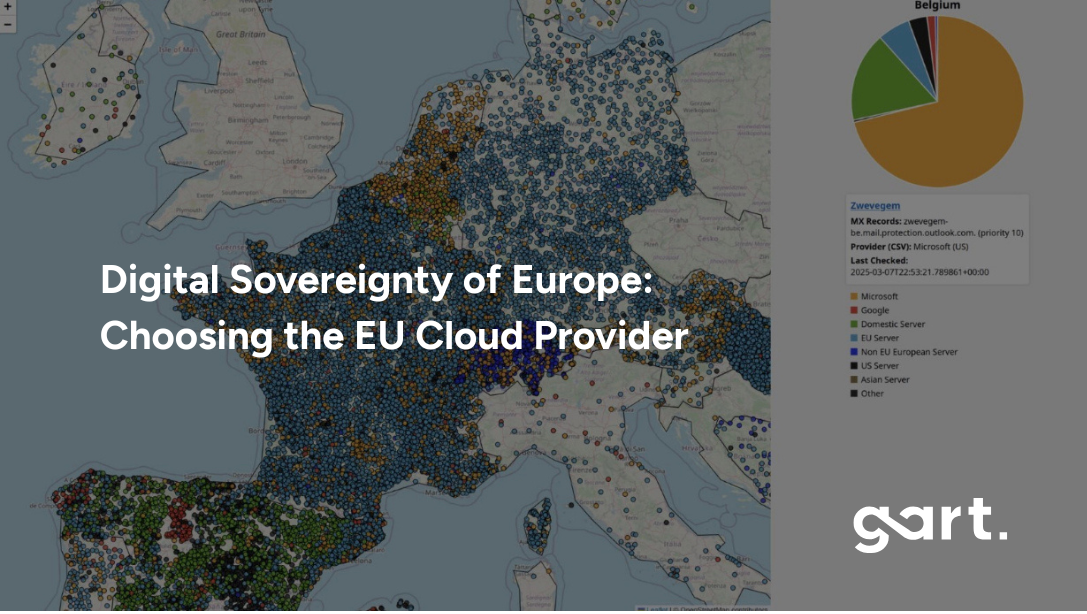
As of 2025, American tech giants control more than 70% of Europe’s cloud infrastructure. That’s a staggering figure — and one that leaves little room for self-determination.
Let’s take, for example, Belgium – Microsoft (with US stored data) has 70% of the market for cloud infrastructure. In Sweden, over 57% of public digital infrastructure — including cities and government services — runs on Microsoft mail servers. In Finland — 77%, Belgium — 72%, Netherlands — 60%, Norway — 64%.
Want to see what cloud services your country is using?
Explore the map: https://lnkd.in/eAdnFt74
Whether it’s a local municipality storing its citizens’ health records or a fintech startup handling millions of transactions, chances are, their data sits on servers operated by foreign entities.
Worse still, this monopoly can lead to vendor lock-in. Companies get tied into proprietary ecosystems that make switching costly and complicated. In contrast, European providers often focus on open-source compatibility and multi-cloud strategies, giving users more freedom and flexibility.
Europe needs its own cloud, not to build walls but to ensure it can compete fairly, uphold its laws, and foster a vibrant digital economy rooted in democratic principles.
The Regulatory Landscape Shaping Europe’s Cloud Strategy
Europe now operates under one of the world’s most comprehensive digital regulatory frameworks. Beyond GDPR, several major laws directly impact how organizations must evaluate cloud providers:
NIS2 Directive – strict cybersecurity and supply-chain obligations for essential and important entities.
Data Governance Act – rules for trusted data sharing across sectors and borders.
Data Act – clarity on who owns and can commercialize IoT-generated data.
Digital Services Act & Digital Markets Act – transparency, accountability, and competition rules for digital platforms.
EU Cybersecurity Act – EU-wide certification schemes for cloud services.
EU AI Act – governance, transparency, and risk-management requirements for AI systems.
This regulatory environment is driving organizations toward EU-native cloud providers that can guarantee compliance without the legal contradictions of foreign jurisdiction.
Key Features to Look for in a European Cloud Provider
Data Residency Within EU Borders
One of the most essential features to demand from any cloud provider in Europe is guaranteed data residency within the EU. Why? Because where data lives determines which laws apply to it. If your business stores sensitive customer information — emails, financial records, medical data — on a cloud hosted in the EU, it's protected by the General Data Protection Regulation (GDPR) and other local laws.
Storing data in the EU ensures:
It cannot be accessed by non-EU jurisdictions without violating EU law.
It remains subject to EU-based audit, regulation, and enforcement.
It aligns with emerging policies like the EU Data Governance Act and Digital Services Act.
EU-based cloud providers like OVHcloud, Scaleway, Hetzner, and Aruba Cloud maintain fully European data center infrastructure, with no dependency on U.S. control. This is particularly important for regulated industries like healthcare, banking, legal, and public services, where compliance breaches can lead to devastating penalties and reputational damage.
Data sovereignty starts with location — but it ends with legal control. Choosing a provider that guarantees both gives you peace of mind and legal clarity.
Metadata Sovereignty — The Hidden Risk Most Organizations Miss
Even when sensitive data is encrypted, cloud platforms still collect metadata:logs, diagnostics, traffic patterns, API calls, access credentials, and telemetry.
This metadata can reveal more about your operations than you might expect — and if handled by a foreign-owned provider, it may fall under foreign jurisdiction even if stored in the EU.
A truly sovereign cloud provider keeps:✔ data in the EU✔ metadata in the EU✔ support services in the EU
This closes one of the most overlooked gaps in compliance architectures.
Transparent Pricing and Vendor Lock-In Avoidance
One common complaint with U.S. hyperscalers is the complexity and unpredictability of pricing. Want to know how much it costs to move 10TB of data out of AWS? You might need a PhD in fine print. By contrast, many European cloud providers prioritize pricing transparency.
Providers like Hetzner and Scaleway offer flat-rate pricing, pay-as-you-go models, and clear invoicing structures. This allows businesses to forecast cloud costs more accurately, especially important for SMEs and startups.
Another key differentiator is freedom from vendor lock-in. Many European providers focus on open-source compatibility and open APIs, which makes it easier to move workloads between cloud platforms or even back on-premises. That’s crucial for long-term agility and cost control.
If you're planning a cloud strategy for the next 5–10 years, flexibility should be as important as functionality.
A Roadmap to Digital Sovereignty (5-Step Framework)
For many organizations, sovereignty is not a single decision — it is a multi-phase transformation.
1. Assess & MapIdentify where your data lives today, who controls it, and which workloads require sovereignty.
2. Govern & SteerEstablish internal roles, policies, data classification, and governance structures aligned with EU directives.
3. Plan & DesignArchitect multi-cloud or sovereign-cloud environments that separate critical data from non-critical workloads.
4. Transform & ImplementMigrate workloads, adopt zero-trust principles, enforce encryption, and integrate monitoring and audit tools.
5. Run & ManageContinuously validate compliance, update classifications, manage identity, and evolve architecture as regulations change.
This structured framework helps organizations modernize cloud infrastructure without sacrificing regulatory alignment or operational agility.
Two Sovereign Cloud Operating Models in Europe
1️⃣ Full EU Isolation Model (Maximum Legal Immunity)
100% EU-owned, EU-operated, EU-law governed infrastructure.No legal backdoors. No foreign jurisdictional exposure.
Best for: government, healthcare, banking, utilities, critical infrastructure.
2️⃣ Guardrail Sovereign Model (Balanced Innovation)
Hyperscaler-grade platforms operated under EU legal entities with EU cryptographic control, EU operations, and technical guardrails.
Best for: regulated enterprises, SaaS, AI platforms, scaleups.
Top European Cloud Providers Supporting Digital Sovereignty
Full EU Sovereign Providers
ProviderCore StrengthHetzner (DE)Cost-efficient, high-performance infrastructureOVHcloud (FR)Full-stack EU hyperscaler alternativeScaleway (FR)Developer-centric cloud & GPU infrastructureT-Systems / Open Telekom Cloud (DE)Government & enterprise complianceAruba Cloud (IT)SME-friendly sovereign infrastructureFull EU Sovereign Providers
Guardrail Sovereign Providers
ProviderPositioningAWS EU Sovereign CloudHyperscaler services under EU legal & operational controlDelos Cloud / GCP / T-SystemsNational guardrail sovereign deploymentsAzure EU entitiesEU-operated, key-controlled environmentsGuardrail Sovereign Providers
OVHcloud (France)
As one of the largest EU-native cloud providers, OVHcloud has become a go-to choice for businesses seeking sovereignty. Based in France, it operates over 30 data centers worldwide with a strong emphasis on EU jurisdiction, sustainability, and open standards.
Strengths:
Extensive product catalog (IaaS, PaaS, Kubernetes, AI)
Certified for GDPR, ISO 27001, HDS, and more
Active participant in Gaia-X
Green data centers with water-cooled servers
OVHcloud offers a user experience similar to AWS but with less vendor lock-in and better EU-specific support.
Scaleway (France)
Scaleway is one of Europe’s most developer-friendly cloud providers, known for its sleek design, open-source tools, and transparent business model. It’s fully GDPR-compliant and headquartered in Paris, with data centers exclusively within the EU.
Highlights:
Flexible virtual instances and GPU-powered machines
Containers, serverless functions, and managed databases
Strong edge and ARM infrastructure for innovation
Scaleway is ideal for startups, SaaS providers, and dev teams who want sovereignty and simplicity.
Hetzner (Germany)
Hetzner has built a stellar reputation for high-performance, affordable cloud and dedicated servers. With its data centers in Germany and Finland, Hetzner ensures GDPR-compliant storage and processing at a fraction of the cost of global hyperscalers.
Unique features:
Flat-rate pricing and extremely low cost-per-GB
Full control with root access and SSH
Ideal for hosting, SaaS, and DevOps workflows
Case Study – Scaling a Global Environmental Platform
To support ReSource International’s global ambitions, Gart Solutions re-architected elandfill.io into a scalable SaaS platform on Hetzner Cloud. The solution replaced costly AWS plans with a Kubernetes-based setup, enabling real-time processing of geospatial and environmental data. As a result, the platform expanded from Iceland to 14 countries, cut infrastructure costs by 60%, and stayed true to its green tech values. Hetzner helped turn a local environmental tool into a global digital platform, without the AWS price tag.
Learn more.
T-Systems / Open Telekom Cloud (Germany)
Backed by Deutsche Telekom, T-Systems operates the Open Telekom Cloud, one of the most secure and enterprise-ready clouds in Europe. With high availability zones in Germany and the Netherlands, it’s perfect for businesses with compliance-heavy workloads.
Best for:
Government agencies and public services
Large enterprises needing hybrid cloud options
Healthcare, finance, and automotive sectors
T-Systems combines German engineering with global IT support, and it's deeply involved in Gaia-X and sovereign cloud initiatives.
Aruba Cloud (Italy)
Aruba Cloud is one of Italy’s leading cloud providers with a robust infrastructure across Europe. Known for its simplicity and cost-effectiveness, Aruba is a great choice for small and mid-sized businesses.
Benefits:
Data centers in Italy, France, Germany, and Czech Republic
Compliant with EU standards
Offers both VPS and enterprise IaaS solutions
If you're looking for sovereign cloud hosting with strong regional presence, Aruba is a top contender.
Industry-Specific Requirements for Sovereign Cloud
Different sectors face different sovereignty obligations. Understanding these nuances helps organizations select the right provider:
SectorSovereignty RequirementPublic SectorFull national & EU legal controlBanking & FinTechDORA-compliant resilience & exit strategiesHealthcareAI Act + GDPR + NIS2 enforcementSaaS PlatformsSovereign AI pipelines & data processingUtilitiesCritical-infrastructure continuity mandatesIndustry-Specific Sovereignty Requirements
Public SectorMust ensure data remains fully under national and EU jurisdiction, with strict auditing, support transparency, and high-assurance certification.
Banking & Financial ServicesSensitive personal and transactional data require robust sovereignty, continuous monitoring, and compliance with EBA, PSD2, and NIS2 guidelines.
Utilities & Critical InfrastructureAs “essential entities,” they must meet strict incident reporting, supply-chain controls, and ensure operational continuity under EU law.
SaaS & Digital PlatformsNeed sovereignty to serve regulated industries and expand globally, while preventing foreign access to customer datasets and analytics pipelines.
These requirements demonstrate why one-size-fits-all cloud strategies rarely work in Europe — sovereignty depends on sector, sensitivity, and scale.
Gaia-X and the Future of Federated Cloud Infrastructure
What Gaia-X Is and Why It Matters
Gaia-X is the EU’s most ambitious project aimed at reclaiming control over Europe’s digital future. Instead of creating another cloud provider, Gaia-X acts as a federated cloud ecosystem, connecting providers, users, and platforms under a common framework of trust, transparency, and interoperability.
It’s designed to ensure:
Sovereign data sharing between companies and countries
Vendor-neutral cloud architectures
Portability and reversibility of services
Full GDPR compliance by design
The ultimate goal of Gaia-X is to enable innovation while maintaining control over how and where data is used. It promotes open standards, multi-cloud strategies, and secure data flows across industries—from finance and energy to health and smart cities.
Gaia-X is not just a tech play. It’s a political and economic declaration that Europe will no longer rely solely on foreign tech monopolies. It’s about building a digitally autonomous future from the ground up.
Who’s Participating in Gaia-X?
Gaia-X brings together a mix of public institutions, startups, established tech companies, research centers, and policy groups. Major players include:
OVHcloud
T-Systems / Deutsche Telekom
Orange Business Services
Atos
Siemens
Scaleway
But it’s not just for the big guys — hundreds of SMEs and open-source projects have joined Gaia-X, contributing to use cases, governance frameworks, and technological standards.
In short, Gaia-X is building a community. By making sovereignty a shared responsibility, it encourages cooperation over competition. It’s about creating a European answer to AWS and Google Cloud without replicating their centralized models.
Gaia-X vs. Traditional Cloud Models
Here’s how Gaia-X fundamentally differs from the global cloud giants:
While Gaia-X won’t replace hyperscalers overnight, it will provide a blueprint for how Europe can innovate without compromising its values.
Sovereign AI — The Next Stage of European Autonomy
As AI adoption accelerates, sovereignty concerns extend far beyond traditional cloud services.
AI systems depend on massive datasets — customer information, behavioral patterns, industrial telemetry, and operational metadata. If this data is processed or stored by non-EU providers, it may fall under non-EU jurisdiction, even if anonymized.
The upcoming EU AI Act introduces strict governance requirements:
transparency of datasets
traceability and auditability
control over model training and inference
risk classifications for high-impact AI systems
For many organizations, this means AI workloads must run on EU-governed infrastructure with EU-controlled metadata, model weights, logging, and monitoring.
Sovereign AI is no longer optional — it will soon be an essential compliance requirement.
Challenges in Adopting EU Cloud Providers
Lack of Feature Parity with Global Giants
Despite their growth, many EU cloud providers still lack the breadth of services offered by hyperscalers. If your organization relies on cutting-edge AI/ML pipelines, advanced serverless infrastructure, or global CDN optimization, you may find some gaps.
For example:
OVHcloud may not match AWS in managed AI services.
Scaleway doesn’t yet offer the global distribution options of Google Cloud.
Hetzner, while powerful, lacks native integrations for enterprise software stacks like Salesforce or Microsoft 365.
The Hidden Cost of Sovereignty
Cloud migration is not only a legal challenge — it is a financial one.
Egress fees ($0.05–$0.09 per GB) create material cost exposure for enterprises migrating regulated workloads. Poorly planned migrations multiply sovereignty risk and long-term operational costs.
Sovereign-first architectures typically reduce egress spend by 30–50% through:
• Pipeline locality redesign• Data gravity containment• Multi-region replication strategies• Exit-optimized storage models
How to Choose the Right EU Cloud Provider
Assessing Security, Scalability, and Support
Choosing the right European cloud provider means balancing technical capabilities with regulatory requirements and business goals. Here's a quick checklist to guide your decision:
Security: Does the provider offer end-to-end encryption, ISO 27001 certification, DDoS protection, and GDPR-compliant data handling?
Scalability: Can the infrastructure scale horizontally and vertically? Are there options for load balancing, container orchestration, or serverless deployment?
Support: Is there 24/7 customer support in your local language? Do they offer clear Service Level Agreements (SLAs) and migration support?
Ecosystem Fit: Does the provider support open APIs, DevOps tooling, and integration with your software stack?
Data Jurisdiction: Are your workloads 100% located in EU jurisdictions, and not subject to non-EU laws like the CLOUD Act?
Providers like Scaleway are ideal for developers and agile startups, while T-Systems suits highly regulated enterprises. Hetzner is unbeatable for performance-per-euro, and OVHcloud delivers full-stack capabilities at scale.
Hybrid and Multi-Cloud Sovereignty Strategies
Not every workload needs to be moved off AWS or Azure today. A practical approach for many businesses is to adopt a hybrid or multi-cloud model:
Use hyperscalers for global edge services or non-sensitive content delivery.
Deploy critical workloads — like customer databases, compliance logs, or analytics pipelines — on sovereign EU clouds.
Leverage Kubernetes, Terraform, and Ansible to orchestrate resources across environments with minimal lock-in.
This strategy offers the best of both worlds: access to global performance when needed, and sovereignty where it matters. Just make sure your orchestration tools support cloud-agnostic deployments.
Conclusion
Europe stands at a crossroads. It can continue to rely on foreign digital giants — or it can take control of its digital destiny. Choosing a European cloud provider is about much more than IT infrastructure.
It’s about:
Preserving privacy
Empowering local innovation
Strengthening legal autonomy
Driving economic growth
https://youtu.be/9VratGTxbZQ?si=LwnmskfbGPQ9RpKE
Providers like OVHcloud, Scaleway, Hetzner, T-Systems, and Aruba Cloud offer real, battle-tested alternatives that align with these goals. The emergence of Gaia-X and sovereign frameworks is accelerating this shift.
How Gart Solutions Supports Sovereign Cloud Transformation
Gart Solutions designs sovereign-first cloud architectures, NIS2/DORA/AI-Act compliant migration roadmaps, egress-optimized multi-cloud strategies, and EU sovereign AI infrastructure.
If your workloads involve regulated data, AI pipelines, public integrations, or cross-border SaaS — your cloud architecture is now a legal architecture decision.
For businesses, the path is clear: audit your cloud strategy, embrace sovereignty where it counts, and invest in a future where Europe owns its cloud — and not the other way around. Contact Us and let's find the best cloud provider, that support your business needs and future plans.
Download our Digital Sovereignty Readiness & EU Cloud Assessment Guide
Digital-Sovereignty-Readiness-EU-Cloud-Assessment-GuideDownload
AI and machine learning are revolutionizing healthcare, especially in the realm of medical devices, bringing in new ways to diagnose and treat patients. But with this fast-paced innovation comes the tricky task of regulating technology that’s constantly evolving.
Agencies like the FDA in the U.S. and regulatory bodies in Europe are working to keep up, finding ways to make sure these high-tech tools are safe, reliable, and effective. By creating flexible guidelines, building collaborative partnerships, and focusing on real-world monitoring, regulators are adapting to the unique challenges of AI-driven healthcare — aiming to support innovation while keeping patient safety front and center.
Differences in Regulatory Approaches to AI in Healthcare: US vs. Europe
1. Regulatory Structure and Oversight
United States: In the U.S., the Food and Drug Administration (FDA) is the main body overseeing AI in medical devices. It operates under a centralized system with clear processes for classifying devices, assessing risks, and approving them. The FDA’s Digital Health Center of Excellence focuses on AI and machine learning (ML) in healthcare, offering resources and guidance for developers. The FDA itself reviews medical AI devices to make sure they’re safe and effective.
Europe: The European Union (EU) and the United Kingdom (UK) follow a more decentralized system, using third-party certifying bodies for conformity assessments instead of direct government oversight. The EU’s regulatory framework is developed by the European Commission, aiming to create consistent regulations across member states for a smooth internal market. In the UK, the Medicines and Healthcare products Regulatory Agency (MHRA) works with the Department of Health to oversee AI in healthcare.
"Unlike in America, we don’t really have a single agency overseeing medical devices development in Europe... The European Commission drives the policy, aiming for harmonization across member states to support a single market."
Lincoln Tsang, a UK-based legal expert
2. Risk-Based Frameworks for Classification
US FDA: The FDA categorizes AI-based medical devices by their risk level and intended use, with a focus on potential patient impact. Lower-risk devices, like general wellness apps, face minimal oversight, while higher-risk tools, particularly those that influence clinical decisions, go through strict evaluation. The FDA’s guidance highlights functionality, deployment context, and patient safety as key factors in deciding the risk level and regulatory needs.
European and UK Standards: Similar to the FDA, regulators in Europe and the UK classify devices based on functionality, intended use, and patient impact. Both the EU and UK use a risk-based approach to assess whether AI software qualifies as a medical device, examining the potential harm and healthcare role of the device. Unlike the FDA’s centralized model, the EU uses third-party bodies for assessments, adding industry involvement to the review process.
3. Approval Pathways and Compliance Assistance
The FDA offers several resources to help developers, including guidance documents, informal consultations, and a Digital Health Policy Navigator to clarify regulatory requirements. A key tool is the Predetermined Change Control Plan (PCCP), which lets developers update AI models without resubmitting for approval, as long as updates follow pre-approved guidelines.
The EU and UK support emerging tech through policy papers and adaptable guidelines. While EU regulators are considering adaptive AI-specific regulation, they currently use general guidance rather than structured pathways like the FDA’s PCCP. Both regions prioritize flexibility, updating guidelines and consulting with industry to keep up with rapid tech advancements in AI and digital health.
"We understand the impact this has on companies, particularly for smaller companies and startups, which we see a lot of in the digital health space. Predictability in regulation is crucial."
Sonja Fulmer, Deputy Director, Digital Health Center of Excellence
4. International Harmonization Efforts
Recognizing the global reach of AI, the FDA, Health Canada, and the UK’s MHRA collaborate to align standards and practices. This teamwork simplifies the approval process for companies across borders. Through groups like the International Medical Device Regulators Forum (IMDRF), these agencies work on creating standards that support global interoperability, safety, and clarity. The IMDRF also offers guidance on issues like machine learning practices, promoting a unified regulatory approach worldwide.
Third-Party Compliance Audits for Healthcare Startups
Third-party compliance audits are key for healthcare startups to ensure their products meet regulatory standards before hitting the market. Companies like Gart Solutions offer specialized compliance audits and consulting services to help startups align with the rules set by bodies like the FDA in the U.S. and certification organizations in the EU.
These third-party services support startups by helping them:
Assess Regulatory ReadinessThrough preliminary audits and gap assessments, firms like Gart Solutions help startups identify their current compliance status and highlight areas needing improvement.
Prepare for Formal CertificationBy simulating official audit conditions, third-party firms enable startups to address potential issues in advance of formal evaluations by agencies like the FDA or European certifying bodies.
Monitor Ongoing ComplianceSince regulations, particularly around adaptive AI, are constantly evolving, third-party auditors often conduct periodic reviews to ensure products stay compliant. For AI-enabled devices, these audits can also include checks on algorithmic fairness, data quality, and post-market performance.
Benefits of Compliance Audits for Startups
Partnering with third-party compliance firms offers several advantages:
Cost Savings: Catching compliance issues early can prevent expensive delays and rework during regulatory approval.
Streamlined Approvals: A thorough pre-audit can smooth the formal certification process, reducing friction with regulatory bodies.
Increased Trust and Transparency: Third-party audits show a startup’s dedication to safety and transparency, boosting stakeholder and consumer confidence.
In regions like the EU, where third-party assessments are a regulatory standard, companies like Gart Solutions help fill the gap for startups that may not have in-house compliance expertise. This support is especially valuable for AI-driven healthcare startups, where standards are both strict and rapidly changing.
Get a sample of IT Audit
Sign up now
Get on email
Loading...
Thank you!
You have successfully joined our subscriber list.
Why Postmarket Surveillance Matters
Postmarket surveillance plays a vital role in regulating AI in medical devices. For high-stakes uses like sepsis detection tools, the FDA requires a monitoring plan to track real-world performance, ensuring devices remain safe and effective across diverse patient populations. This process means manufacturers need to keep an eye on model bias, data quality, and overall device performance in everyday clinical settings. By actively managing these factors, postmarket surveillance helps reduce risks from data issues or model bias, supporting consistent, reliable performance over time.
Trends and the Future of Regulation
With AI becoming a bigger part of healthcare, regulators are likely to move toward more flexible, adaptive policies. Emerging challenges, like continuous-learning AI algorithms, are pushing agencies to rethink how they manage the entire lifecycle of these technologies. Quality assurance, postmarket surveillance, and adaptable regulations are all set to play a larger role as AI advances.
The FDA is working on guidelines for adaptive AI, expected to be released soon, which will help developers as they build continuously learning algorithms. Meanwhile, regulatory bodies in the UK and EU are exploring similar frameworks suited to their own standards, promoting international alignment and consistency.
Conclusion
The regulatory landscape for AI in healthcare is advancing rapidly to keep pace with technological developments. With their risk-based frameworks, both the FDA and European regulators are focused on ensuring the safety and efficacy of AI-enabled medical devices while supporting innovation. Through resources like the Digital Health Center of Excellence and international harmonization initiatives, agencies are setting the stage for a future where AI can safely and effectively transform healthcare, with robust postmarket surveillance and flexible change management strategies forming the backbone of this evolving regulatory framework.
Data is power. But in Europe, much of that power is still in foreign hands.
Despite Europe’s strong regulations and fast-growing tech sector, the continent remains heavily dependent on cloud services from American companies like Amazon, Microsoft, and Google.
While American these tech giants dominate the cloud computing landscape, European leaders are asking a crucial question: How can Europe achieve true digital independence without sacrificing innovation and economic growth?
Can Europe really call itself digitally sovereign?
Why Digital Sovereignty Matters
Digital sovereignty means having control over your digital infrastructure — including where your data is stored, how it is protected, and who can access it. It’s not about isolation. It’s about resilience, freedom of choice, and protection from external risks.
Today, the situation looks troubling:
92% of Western data is hosted in the U.S.
80% of global cloud data is controlled by just five non-European companies
Microsoft and Amazon alone control 38% of the European cloud market
That means that even if your data is physically stored in Europe, it may still be under the legal reach of U.S. authorities — thanks to laws like the CLOUD Act and FISA 702, which allow American surveillance of data stored abroad by U.S. companies.
The problem goes beyond simple market competition. When critical data and digital infrastructure rely on foreign-controlled systems, Europe loses control over its digital destiny. Sensitive government information, business data, and personal information of European citizens flow through systems governed by foreign laws and policies.
Digital sovereignty isn't just about nationalism – it's about practical control and security. When a European hospital's patient records are stored on American servers, or when a government's classified information passes through foreign-controlled networks, real questions arise about privacy, security, and independence.
The EU's digital sovereignty agenda aims to reduce reliance on foreign technology, enhance infrastructure, and address privacy concerns while facing challenges from U.S. and Chinese dominance. This isn't about shutting out the world, but about having genuine alternatives and maintaining strategic autonomy.
“Europe missed the first wave of the cloud. If we miss the second one, we’ll be stuck in digital dependency.”
– Thierry Breton, EU Commissioner for the Internal Market
Real Risks from Real Cases
This isn’t just a theoretical concern. Several well-known cases have exposed how foreign control over cloud infrastructure can impact European users:
The Microsoft Ireland case: U.S. officials requested access to emails stored on Irish servers. This raised alarm about how far U.S. legal power can reach.
The Privacy Shield collapse: An EU-U.S. data-sharing deal was invalidated because U.S. surveillance conflicted with European privacy laws.
Dutch government disruption: U.S. sanctions led to service interruptions in Europe, affecting even innocent bystanders.
These examples prove that relying on non-EU cloud providers exposes Europe to legal uncertainty, geopolitical risks, and potential data misuse.
The AI Factor: More Data, More Dependency
The rise of AI adds another layer of urgency. Modern AI systems need huge amounts of computing power, which is mostly available through major cloud platforms. But if European AI models are trained or hosted on non-EU infrastructure, it creates legal and ethical conflicts, especially with the new EU AI Act.
Hosting AI in the wrong cloud can violate EU data protection rules — even if developers follow best practices. That’s why digital sovereignty is not just a legal issue anymore. It’s becoming a strategic priority.
Get a sample of IT Audit
Sign up now
Get on email
Loading...
Thank you!
You have successfully joined our subscriber list.
European Alternatives Taking Shape
Europe has started several initiatives to build its own cloud capacity. Some key projects include:
Slow adoption, lack of traction, and the gap between European ambitions and current reality.
1. Gaia-X: The Ambitious (But Struggling) Vision
“Europe contributes nearly 25% of global cloud revenues but owns less than 2% of cloud infrastructure.”
– Gaia-X
Gaia-X was Europe's flagship attempt at creating a federated cloud infrastructure. Launched with great fanfare, it promised to be "a federated European cloud platform big enough to challenge the market dominance of the US hyperscale providers and meet the data sovereignty needs of businesses".
However, the project has faced significant challenges. Critics argue that by including major American tech companies in the initiative, Gaia-X risks becoming what some call "a trojan horse for Big Tech in Europe". Six years after its launch, that promise of digital sovereignty "rings hollow".
2. EuroStack: The New Hope
Learning from Gaia-X's struggles, a new initiative called EuroStack is gaining momentum. The EuroStack is described as "the continent's last chance for technological sovereignty in the era of AI".
Unlike Gaia-X, EuroStack takes a more focused approach to building genuinely European alternatives. By 2025, EuroStack is expected to expand into AI regulation, blockchain identity, and provide businesses with sovereign cloud Europe solutions, AI governance frameworks, and open-source software alternatives to AWS and Azure.
3. AWS European Sovereign Cloud: A Compromise Solution
Even American companies are responding to European demands for sovereignty. AWS European Sovereign Cloud, launching in 2025, offers enhanced digital sovereignty for EU organisations. While this isn't a European-owned solution, it represents an attempt to address sovereignty concerns within existing market structures.
4. The Cloud and AI Development Act
The European Commission is taking legislative action. In 2025, the Commission will propose the Cloud and AI Development Act, with the aim to at least triple the EU's data centre capacity within the next 5 to 7 years and fully meet the needs of EU businesses and public administrations by 2035.
What Makes a Real European Alternative?
For Europe to achieve genuine digital autonomy, several key elements must be in place:
Local Ownership and Control: The infrastructure must be owned and operated by European entities, subject to European law and governance.
Open Standards: Unlike proprietary systems that create vendor lock-in, European alternatives should embrace open standards that promote competition and innovation.
Privacy by Design: European solutions must put privacy and data protection at their core, reflecting European values and legal requirements like GDPR.
Economic Viability: Alternatives must be competitive in terms of performance, reliability, and cost. Sovereignty without competitiveness is not sustainable.
Innovation Capacity: European solutions need to keep pace with technological advancement, particularly in areas like artificial intelligence and machine learning.
Are There Any European Cloud Alternatives?
Yes — and their number is growing. While they may not yet match AWS or Azure in size, they offer better compliance, lower legal risk, and strong alignment with European values.
Some examples include:
OVHcloud (France) – A leader in sovereign and secure cloud infrastructure
Hetzner (Germany) – Affordable, high-performance hosting with full EU compliance
Elastx (Sweden) – Sustainable, Kubernetes-based cloud for developers
Scaleway (France) – Eco-friendly provider with a wide range of cloud services
STACKIT (Germany) – Designed for enterprise needs and full data control
IONOS Cloud (Germany/UK) – Reliable infrastructure for EU-based clients
These providers prioritize GDPR compliance, data residency, and open-source standards — things global hyperscalers often struggle with.
Public vs. Local Cloud: What’s the Difference?
CriteriaPublic Hyperscalers (AWS, Azure, GCP)EU-Based Providers (OVH, Hetzner, etc.)Data SovereigntyMay store data worldwideHosted entirely in the EULegal RiskSubject to U.S. lawsGoverned by EU lawsSupportGlobal, but less localizedLocal support, EU languagesPerformanceFast globallyOptimized for EU performanceFlexibilityMany services, but risk of lock-inCloud-agnostic, easier to migrateComplianceGeneral certificationsTailored to EU-specific regulations
How to Build Cloud Independence
European companies and governments don’t have to “go it alone” or cut ties with global platforms. Instead, they can take a hybrid and strategic approach:
Mix Providers: Use both global and local providers. Keep sensitive workloads in EU-based clouds.
Classify Workloads: Not all data is equal. Critical or regulated data should always stay on sovereign infrastructure.
Ensure Portability: Use open standards like containers and Infrastructure-as-Code (IaC) to avoid vendor lock-in.
Audit Regularly: Know where your data lives, who controls it, and whether you can move it if needed.
What Comes Next?
Digital independence doesn’t happen overnight. It’s a journey — and Europe is now on the path. The key is not to reject collaboration with U.S. providers, but to make smarter choices:
✅ Choose partners that match your values✅ Protect your data with the right legal frameworks✅ Plan for long-term resilience, not just short-term convenience
As Margrethe Vestager, VP of the European Commission, put it: “Digital infrastructure is no longer just technical — it’s geopolitical.”
And as the experts at Gart Solutions say:
“Cloud independence isn’t about cutting ties. It’s about choosing your ties wisely.”
✅ Start with a Cloud Audit
You can’t manage what you don’t measure.Ask yourself:
Where is your data stored?
Which jurisdictions govern it?
Are you prepared to switch providers if needed?
A simple cloud audit will reveal your current risks and help you make smarter, future-proof decisions.
👉 Need help getting started? Contact us for guidance on building your path to cloud independence.
Conclusion
The future of European cloud is not just about technology. It’s about trust, freedom, and control. By investing in sovereign solutions and rethinking cloud strategies, Europe can finally take back ownership of its digital destiny.